1. What is Shadow Boxing? The Art of Punching the Air
Do you want to burn up to 800 calories per hour and relieve extreme stress, but hate crowded gyms or investing tens of millions of dong in workout equipment? The answer lies right in the space before you: Shadow Boxing (also known as punching the wind or punching the air).
More than just swinging your arms into thin air, Shadow Boxing is the art of simulated confrontation. Originating from the mandatory training plans of professional boxers to refine technique, train footwork, and build tactical thinking before entering the ring, this discipline has evolved into one of the most instinctive and powerful workout methods. When executing combinations, you are not just moving your body; you are fighting your most formidable opponent: your own reflection.

The biggest obstacle to working out at home is often limited space and a lack of equipment. Shadow Boxing completely shatters those barriers. You do not need a heavy punching bag, do not need expensive gloves, and absolutely do not need a training partner. This is why this discipline is sweeping through healthy living communities worldwide as a minimalist workout solution that releases maximum energy.
"In Shadow Boxing, empty space is not nothingness. It is the truest mirror reflecting your technique, speed, and willpower."
To clearly see the superiority of the art of "punching the air" compared to other traditional forms of cardio, look at the actual performance comparison table below:
| Comparison Criteria | Shadow Boxing | Treadmill Running | Indoor Cycling |
|---|---|---|---|
| Investment Cost | $0 (No equipment needed) | Very high (Buying a machine or gym membership) | Medium to high (Buying a bike) |
| Joint Pressure | Low (No hard impact) | High (Continuous impact on knees) | Low |
| Activated Muscle Groups | Full body (Shoulders, arms, back, core, legs) | Mainly lower body | Mainly thighs and calves |
| Brain Benefits | High concentration, fast reflexes | Easy to get boring and repetitive | Easy to get boring |
By harmoniously coordinating your breathing, straight punches (jabs), hooks, and slip movements, Shadow Boxing forces your brain to operate at full capacity. This is not just a physical workout; it is a state of active meditation that helps you instantly shake off all work pressure, returning a sharp mind and a toned, flexible physique.
2. Dual Benefits: Ultimate Calorie Burning and Mental Stress Relief
You leave the office at 6 PM with a stiff neck and shoulders, a brain paralyzed by "tab overload", and an exhausted body. Choosing to lie on the sofa scrolling through your phone is actually a biological trap. It does not regenerate energy; it only prolongs mental fatigue. The key to breaking this cycle of exhaustion is high-intensity physical activity. This is not simply about sweating, but a comprehensive "reset" process for both body and mind.
When you start moving, your body triggers a powerful chain of biochemical reactions, delivering immediate dual benefits: releasing tension accumulated in muscle fibers and clearing "clutter" from your thoughts.

Exceptional Physical Health: Activating the Automatic Fat-Burning Machine
Many people mistakenly believe that working out only burns calories during the session. In fact, science proves the effects go far beyond that thanks to the EPOC (Excess Post-exercise Oxygen Consumption) effect - also known as the "afterburn" state. When you perform resistance training or High-Intensity Interval Training (HIIT), your body is forced to consume more oxygen afterward to recover. This process keeps your metabolic rate elevated continuously for up to 24 hours after the workout ends.
- ✓ Boost cardiovascular speed and endurance: Regular physical activity increases stroke volume, helping the heart pump blood more efficiently, reducing pressure on blood vessel walls, and enhancing oxygen delivery to the entire body.
- ✓ Optimize flexibility and agility: Multi-directional movements help lubricate joints and stretch muscle groups shortened by prolonged sitting, thereby eliminating chronic musculoskeletal pain at its root.
| Training Method | Calories Burned (60 minutes) | Core Physical Benefits | EPOC Activation Level |
|---|---|---|---|
| HIIT (High-Intensity Interval Training) | 600 - 800 kcal | Maximum fat burn, rapid cardiovascular endurance boost | Very High (up to 36 hours post-workout) |
| Weight Training (Resistance) | 300 - 400 kcal | Build muscle, increase bone density, shape physique | High (muscle recovery and building) |
| Running (Moderate Pace) | 500 - 600 kcal | Increase lung capacity, build mental resilience and endurance | Medium |
Mental Clarity: A Biological "Reset" Button for an Overloaded Brain
The greatest pain for mental workers is not physical fatigue, but mental exhaustion (Burnout). When stress is prolonged, Cortisol levels rise, damaging brain cells in the hypothalamus, leading to memory decline and poor concentration. Exercise is the most powerful natural antidote.
As soon as your heart rate goes beyond its normal threshold, your brain releases a beneficial chemical "storm":
- ✓ Endorphins and Dopamine: The ultimate hormones for happiness and reward. They quickly soothe stressed brain areas, bringing a gentle feeling of euphoria and sweeping away all accumulated anxiety.
- ✓ BDNF (Brain-Derived Neurotrophic Factor): A special protein that helps stimulate the production of new brain cells and enhances brain connectivity. This is why you often come up with your most creative ideas right after a run or lifting weights.
"Exercise is not a punishment for what you ate, but a celebration of what your body can do. It is when the mind is completely freed from deadlines and invisible pressures."
Investing 30 to 45 minutes of physical activity daily is not a waste of working time, but a smart investment to double your productivity for the following working hours. A body full of vitality and a sharp mind are the strongest foundation for you to conquer every goal in life.
3. Guide to Basic Shadow Boxing Techniques for Beginners
Do you stand in front of the mirror, throwing punches into thin air and feeling absolutely ridiculous? Your limbs feel clumsy, you lose your balance after every punch, and after just two minutes, your lungs feel like they are going to explode? This is a common experience for most beginners. You are "flailing your arms" on instinct rather than truly controlling your body. Shadow Boxing is not mindless arm-waving, but the art of simulated combat that requires absolute precision from your heels to the top of your head.
To turn those training moments in front of the mirror into a top-tier fat-burning session and build real combat reflexes, you need to master the movement structure below.
Step 1: The Fighting Stance - The Foundation of Every Champion
Every powerful punch originates from the ground, not from the arm muscles. If your stance is loose, your punching power will be neutralized and you can easily be knocked down by a simple tap.
- Determine your lead foot: If you are right-handed, step your left foot forward (Orthodox stance). If you are left-handed, step your right foot forward (Southpaw stance).
- Distance and angle: Keep your feet shoulder-width apart. Your front foot points straight forward, while your back foot is angled at about 45 degrees. Imagine you are standing diagonally on two parallel train tracks; never stand in a straight line as this causes loss of balance.
- Weight distribution: Slightly bend both knees, distributing your body weight evenly 50/50 on both legs. Slightly lift your back heel off the ground to be ready for explosive power.
- The defense: Keep your elbows tucked close to your ribs to protect your liver and midsection. Put your hands up to cover your face: your back hand pressed close to your chin, your front hand raised high at eye level. Tuck your chin down close to your collarbone to protect your jaw.
Step 2: Footwork - The Dance of Distance Control
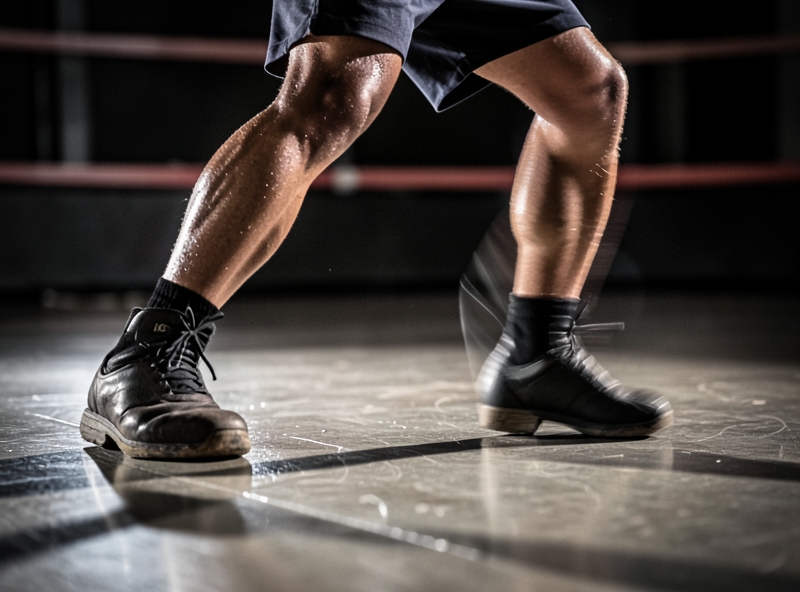
The golden rule of footwork in Boxing is extremely simple but often overlooked: Move the foot closest to the direction you want to go first, and let the opposite foot follow. This keeps the distance between your feet stable, ensuring you never "trip over yourself".
- Moving forward: Take a short step forward with your front foot, then drag your back foot forward by an equivalent distance.
- Moving backward: Step your back foot backward first, then pull your front foot back to maintain the same distance.
- Moving left: Step your left foot to the left, and let your right foot follow.
- Moving right: Step your right foot to the right, and let your left foot follow.
"In boxing, your feet put you in a position to strike and get you out of danger. Without footwork, your fists are completely useless."
Step 3: Mastering the 4 Basic Punches (The Big Four)
Do not try to throw complex punches before optimizing the trajectory of these 4 classic strikes. Focus on rotating your hips and shoulders instead of just using arm strength.
| Punch | Main Source of Power | Simulated Target | Common Mistakes to Avoid |
|---|---|---|---|
| Jab (Lead Straight Punch) | Push off the lead foot, slightly rotate the lead shoulder. | Opponent's nose or chin. | Dropping the rear hand when jabbing, exposing the chin. |
| Cross (Rear Straight Punch) | Pivot the rear heel, fully rotate the rear hip and shoulder. | Directly to the opponent's face. | Failing to rotate the hips, punching with pure shoulder power causing overreaching. |
| Hook (Side Punch) | Pivot the heel on the same side, twist the hips as the axis of rotation. | Opponent's temple or jaw. | Flaring the elbow too far from the body, which dilutes the strike's power. |
| Uppercut (Upward Punch) | Bend knees to gather momentum, drive power from the legs up to the hips. | Opponent's chin. | Dropping the hand too low before throwing the punch, exposing your own defense. |
When executing these punches in Shadow Boxing, remember to maintain a squeeze at the end of the strike. This means at the exact moment the punch hits the "simulated target", squeeze your fist tight for a tenth of a second before snapping your hand back to the starting guard position as quickly as possible in a straight line.
Step 4: Synchronizing Your Breathing - The Engine of Stamina
Many beginners tend to hold their breath when punching because they focus too much on striking power. This causes muscles to tense up, quickly building up lactic acid and leading to exhaustion after just a few combinations. Apply the breathing formula of professional fighters: Exhale actively through your mouth when striking - Inhale naturally through your nose when recovering your guard.
When you throw a punch (Jab, Cross, Hook, or Uppercut), make a short, sharp sound like "Tss" or "Shh" through your teeth. This breath automatically braces your abdominal muscles, protecting your core, while releasing chest pressure so you do not run out of breath. A breathing rhythm perfectly synchronized with the rhythm of your fists is the key to maintaining a continuous Shadow Boxing intensity for 3 to 5 rounds without a drop in performance.
4. Secrets to Setting Up an Effective Shadow Boxing Session at Home
Many people mistakenly believe that Shadow Boxing is just mindlessly flailing your arms in the air to work up a sweat. This fatal mistake not only quickly exhausts and bores you, but also ruins your shoulder joints and wrists due to incorrect punching technique. Shadow Boxing is actually a mental battle with an "invisible enemy" – accurately reflecting your tactical thinking and body control. To transform a small living room space into a professional ring with ultimate fat-burning efficiency, you must strictly follow the standard training plan below.
Step 1: Activate the Nervous System and Warm Up Joints (Warm-up)
Never throw a powerful punch when your body is not ready. Warming up in boxing is not just to warm up the muscles, but more importantly to activate the motor nervous system and lubricate key rotating joints, including: ankles, hips, and shoulders. Spend 5 to 7 minutes on the following movement sequence:
- Light Jump Rope (3 minutes): Build rhythm for your feet and warm up your calves.
- Joint Mobility (2 minutes): Focus deeply on the shoulder, hip, and wrist joints using wide-range circular motions.
- Dynamic Stretching (2 minutes): Perform lunges combined with torso twists to stretch the intercostal muscles – the launching pad for every powerful punch.
Step 2: Use a Mirror – The Strictest "Coach"
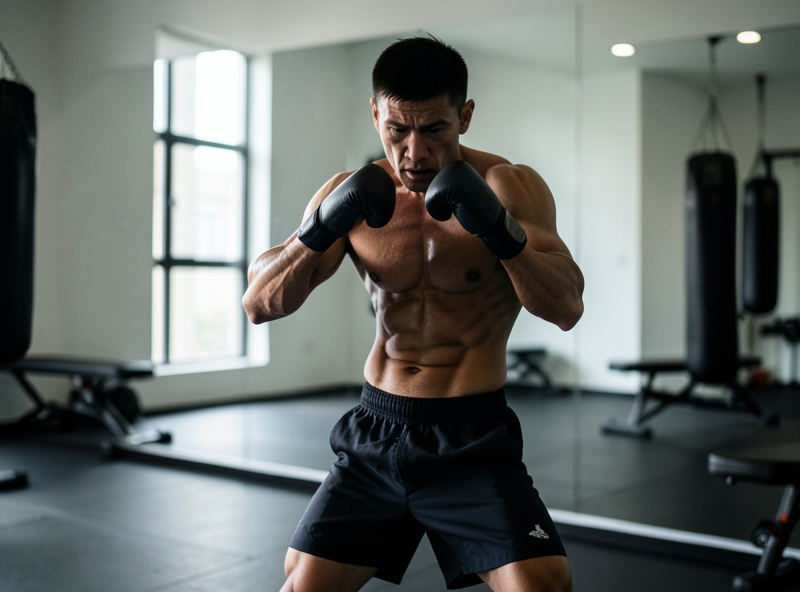
Practicing Shadow Boxing without a mirror is like practicing shooting in the dark. The reflection in the mirror is the most honest teacher, pointing out fatal flaws in your defense and offense. When standing in front of the mirror, constantly scan with your eyes and self-check the following technical details:
- Chin Position: Is your chin tucked deep down to your chest to avoid counter-attacking uppercuts?
- Guarding Hand: When your right hand throws a straight punch (cross), is your left hand pressed tightly against your cheek to protect the temple area? Or is it hanging loose?
- Hip and Heel Rotation: Are you using force from your arm (arm punch) or explosive force from the ground, transmitted through the rotation of your heel and hips?
Step 3: Set Up the Round Structure (Rounds)
To achieve optimal cardiovascular (cardio) benefits and build muscle endurance, you need to divide your workout into clear rounds that simulate real fight pacing. Apply the formula of 3 to 5 rounds immediately (3 minutes per round, 1 minute rest between rounds) with the specific goals below:
| Round | Time | Technical Focus | Mental Intensity |
|---|---|---|---|
| Round 1: Establishing Distance | 3 Minutes | Use only the lead straight punch (Jab) combined with forward, backward, and lateral footwork movement. Control the distance. | Light, focusing on the fluidity of footwork. |
| Round 2: Offensive Combinations | 3 Minutes | Coordinate basic combos: 1-2 (Jab-Cross), 1-2-3 (Jab-Cross-Lead Hook). Pay attention to maximum hip rotation. | Medium, emphasizing fluidity when connecting punches. |
| Round 3: Defense and Counter-attack | 3 Minutes | Integrate defensive techniques (Slip, Roll) immediately after throwing a punch. Imagine the opponent is counter-attacking you. | High, continuous tactical thinking. |
| Round 4: Explosive Acceleration (Optional) | 3 Minutes | Continuous high-speed punching (Volume punching) during the last 10 seconds of each minute to push your heart rate to the maximum threshold. | Extreme, burning excess fat and training mental stamina. |
"In Shadow Boxing, where your mind is, there your punch is. Don't just look into empty space, look through your imaginary opponent in the mirror and strike with intent."
Step 4: Cool-down – The Key to Recovery
When the final round bell rings, don't rush to collapse onto the floor. Stopping movement abruptly causes blood to pool in your limbs, causing dizziness and prolonging muscle soreness the next day. Spend 5 minutes performing Static Stretching exercises:
- Shoulder and Triceps Stretch: Pull your elbow behind your head, hold each side for 20 seconds to relieve pressure on the shoulder blade joint.
- Chest Stretch: Interlace your hands behind your back, push your chest forward to expand the chest cavity and stretch the muscle groups that were contracted during the guard stance.
- Calf and Hamstring Stretch: Bend forward deeply, keeping your knees straight to soothe the leg muscles that worked continuously throughout the workout.
5. Conclusion
Many people mistakenly believe that Shadow Boxing is just a few meaningless punches thrown into the air to release energy before starting the main workout. In reality, this is the most honest mirror reflecting your mental and physical control capabilities. When standing before empty space, with no heavy bag to bounce back and no actual opponent pressing you, you are forced to create your own pressure and face yourself. That is when Shadow Boxing goes far beyond the limits of a regular physical exercise, becoming an art of unifying Body - Mind - Spirit: training resilient muscles, sharpening mental focus, and shaping sharp tactical thinking.
"Shadow Boxing is not a fight with an invisible opponent, but a process of conquering the chaotic instincts within yourself."
The fatal mistake of most beginners is trying to throw the fastest, strongest punches from the very first seconds. The consequence is broken posture, loss of balance, and joint injuries. The ultimate rule here is: Slow is smooth, and smooth is fast. The initial phase requires you to suppress your ego to focus entirely on technique. Feel the path of force starting from the heel, transferring through the hips, rotating along the spine before exploding into the fist and immediately returning to defense. Once every muscle fiber has memorized the movement (muscle memory), speed and power will naturally follow as an inevitable result.

Maintaining consistency with Shadow Boxing does not require hours of exhausting workouts, but rather a steady 10-15 minutes daily with complete focus. Stand in front of the mirror, visualize a real opponent in front of you, and begin to master your own space. The feeling of absolute control over every breath, every footwork, and a razor-sharp mental toughness is the most deserving reward for those who dare to persist from the quietest steps.