1. Kettlebell: The Philosophy Behind the Intersection of Strength and Fluidity
Most modern trainees fall into an invisible trap: possessing massive but rigid, inflexible, and injury-prone muscles during real-world movement. Over-isolating muscles with gym machines unintentionally destroys the body's natural coordination. The Kettlebell emerged not as a passing trend, but as a perfect solution to this difficult puzzle. With its signature off-center design, the kettlebell forces the body to move as a unified whole, where explosive strength and fluid flexibility are no longer mutually exclusive.
"True strength does not lie in the size of individual muscle bellies, but in the ability to seamlessly transfer force from the heels to the crown of the head."
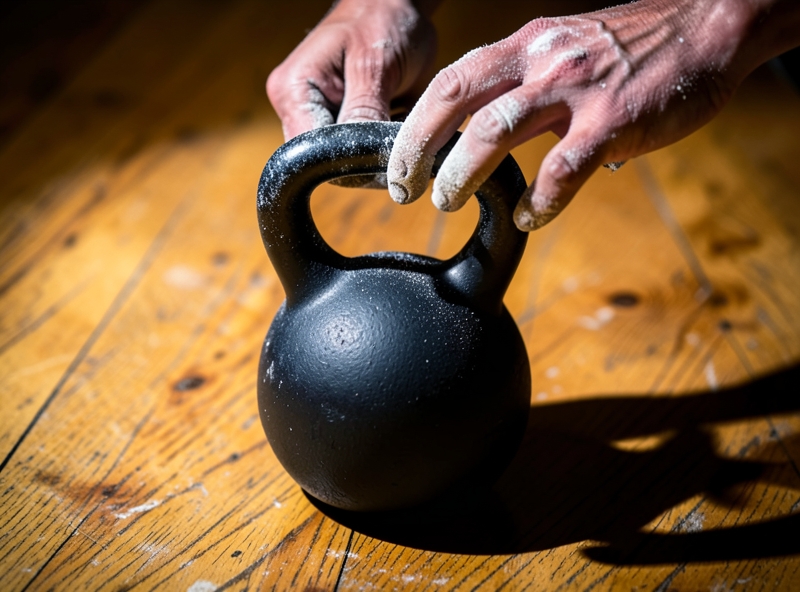
The uniqueness of the kettlebell lies in its physical structure. The center of gravity of the bell lies outside the palm of the hand, constantly shifting along the trajectory of movement. This requires the stabilizer muscles and the joint system to work continuously to maintain balance. To clearly understand this revolutionary difference, look at the comparison table below:
| Comparison Criteria | Traditional Dumbbell | Kettlebell |
|---|---|---|
| Center of Force | Fixed within the palm of the hand. | Located outside the handle, constantly shifting. |
| Core Activation | Moderate, primarily focusing on target muscles. | Extremely high, the core must brace hard to counter centrifugal force. |
| Practical Application | Building localized muscle size (Hypertrophy). | Developing posterior chain strength, increasing joint flexibility (Mobility). |
The philosophy of kettlebell training is most clearly defined through two classic movements, representing two opposite yet perfectly complementary extremes: the Kettlebell Swing and the Turkish Get-up.
The Kettlebell Swing is the embodiment of explosive posterior chain strength. This is not a shoulder exercise, but a powerful hip hinge. When performed with proper technique, this movement generates massive centripetal force, forcing the glutes, hamstrings, and the entire lower back to coordinate rhythmically to produce and decelerate force in an instant. This is the foundation of speed, power, and protecting the spine from daily injuries.

Conversely, the Turkish Get-up (TGU) is a song of slowness, control, and ultimate resilience. Starting from a lying position on the floor, you must stand up with a kettlebell overhead and lie back down without letting the bell drift from the vertical axis. The TGU exposes every weakness in your body: from lack of mobility in the ankles and hips to instability in the shoulders. Mastering the TGU means you have reprogrammed your natural movement capacity and optimized the kinetic chain of your entire body.
Integrating kettlebells into your training program is not merely adding a new exercise. It is a paradigm shift from "training for muscle size" to "training the body to move intelligently". The fluidity gained from controlling an off-center mass of iron is the key to unlocking peak athletic performance, helping you move faster, last longer, and remain resilient against the test of time.
2. Kettlebell Swing: The Art of Unleashing Explosive Power from the Posterior Chain
More than 90% of gym-goers out there are ruining their lower backs by performing the Kettlebell Swing incorrectly. They turn a premium posterior chain development exercise into a half-hearted squat, overloading the knee joints and hitting their shins with the weight. In reality, the Kettlebell Swing is not an exercise for the quads or shoulders; it is an ultimate weapon to unleash explosive power if you hold the golden key: the Hip Hinge movement.
To master this exercise, you must distinguish the core biomechanical difference between a Hinge and a Squat. In a Squat movement, the center of gravity shifts vertically (up/down), with the knees pushing forward. Conversely, the Hip Hinge is a horizontal (forward/backward) movement. The center of gravity shifts backward by pushing the hips back maximally, keeping the shins nearly perpendicular to the ground.
| Criteria | Squat Technique (Common Mistake) | Hip Hinge Technique (Correct) |
|---|---|---|
| Primary Axis of Movement | Knee-dominant | Hip-dominant |
| Path of the Weight | Vertical up and down | Arc-shaped, projecting force forward |
| Dominant Muscle Groups | Quadriceps (Quads) and lower back | Glutes, Hamstrings, and erector spinae |
| Force Sensation | Knee fatigue, lower back soreness | Hamstring tension, maximum glute activation |
Imagine your posterior chain as a stretched bow. As you hinge your hips backward, your glutes and hamstrings accumulate maximum potential energy. Right at the limit, an explosive hip snap releases all this energy, transferring force through the torso and driving the kettlebell upward by inertia. Your arms at this point only act as two connecting chains; absolutely do not use your shoulder muscles to pull the weight.

"The Kettlebell Swing does not generate power from isolated muscles; it trains the body how to connect kinetically from the heels to the top of the head to unleash explosive force in a split second."
Besides building buns of steel and a solid back, the biomechanics of the Kettlebell Swing create an unprecedented cardiovascular effect. The continuous transition from peak muscle contraction to active stretching under the pressure of the weight creates an enormous oxygen demand. With just 10 minutes of Swings at the right intensity, you can push your heart rate into Zone 4/Zone 5, burning calories equivalent to sprinting while completely eliminating negative impact on the ankle and knee joints.
If your goal is to possess a lean, toned physique, explosive speed, and the cardiovascular system of an endurance athlete, stop lifting weights half-heartedly. Incorporate the Kettlebell Swing into your training program today, focusing on hip snap speed rather than weight, and feel the raw energy released.
3. Turkish Get-up: The Pinnacle of Core Stability and Shoulder Mobility
Do hundreds of exhausting Plank sets or heavy overhead shoulder presses still fail to save you from nagging lower back pain or unstable shoulder joints? The sad reality is: you can be very strong in isolated muscle groups, but completely helpless in connecting them into a unified whole. The Turkish Get-up (TGU) is the ultimate test that thoroughly resolves this broken connection. More than just an exercise, the TGU is a perfect movement diagnostic system, forcing the entire body to function as a single entity under continuous loaded tension.
"The Turkish Get-up doesn't allow you to cheat. Just one weak link in your wrist, shoulder, or hip, and the kettlebell will punish you immediately. This is the pinnacle of force integration."
To master this technique, the body must undergo a complex mechanical transition from the ground to a standing position, divided into three core movement phases:
| Movement Phase | Core Mechanical Requirements | Force Transfer Benefits |
|---|---|---|
| 1. The Roll to Post (From ground to elbow and hand) | Brace the diagonal core, engage the lats to tightly "lock" the shoulder blades (shoulder packing). | Learn to generate force from the ground, converting hip rotation into vertical drive. |
| 2. High Bridge to Sweep | Maximize hip extension through the gluteus maximus while stabilizing the loaded shoulder joint at a 90-degree angle. | Enhance hip mobility and pelvic control under dynamic tension. |
| 3. Lunge to Stand | Stabilize the vertical spinal column, coordinating multiple joints (ankle, knee, hip, shoulder) to resist load. | Reprogram natural upright posture, increasing unilateral explosive strength. |
The key that sets the TGU apart lies in isometric core activation under loaded tension. Unlike traditional crunches, your core in the TGU acts as a solid protective belt, resisting rotational and compressive forces from the kettlebell constantly shifting its center of gravity overhead. You are not just bracing your abs; you are learning to breathe and maintain stable intra-abdominal pressure throughout the entire extended movement chain.
Alongside this, shoulder stability is challenged at the most demanding level. As you rotate your body beneath the weight, the rotator cuff muscles must continuously micro-adjust to keep the head of the humerus securely positioned inside the joint socket. This is an unmatched shoulder rehabilitation and injury prevention exercise, turning vulnerable, fragile shoulders into solid steel supports.

If you want to possess a body with no weak points—an exceptionally agile movement system that withstands the test of time and intense workouts—incorporate the Turkish Get-up into your training program today. Start with a light weight to master the movement trajectory, feel the distinct muscular connection second by second, and you will see your strength break through to a whole new level.
4. The Mutual Complementarity of Swing and Turkish Get-up in Workout Programming
More than 90% of gym-goers today are stuck in a disastrous loop: either rushing into explosive exercises recklessly leading to joint overload, or overusing slow isolation movements that make the nervous system lazy. The combination of the Kettlebell Swing and the Turkish Get-up (TGU) is the most definitive answer to this paradox. This is not simply combining two exercises together, but the perfect intersection of two movement extremes: ballistic dynamics and static control (Grind).
The Kettlebell Swing represents the "Yang" - an explosion of force, using the hip hinge movement to generate maximum power from the posterior chain, pushing the heart rate to its peak. Conversely, the Turkish Get-up is the "Yin" - a slow, highly focused sequence of movements that forces all core muscle groups and the shoulder joint to constantly recalibrate to keep the weight stable independently in three-dimensional space. When combined, they neutralize each other's weaknesses, creating a body that has both storm-like explosive power and the durability and solidity of a fortress.
| Comparison Criteria | Kettlebell Swing (Dynamic Part) | Turkish Get-up (Static/Control Part) |
|---|---|---|
| Movement Nature | Explosive force generation, fast rhythm, curved trajectory. | Step-by-step control, multi-planar movement, slow speed. |
| Biomechanical Focus | Posterior chain (Glutes, hamstrings, lower back). | Shoulder joint, core muscles, hip and spine mobility. |
| Neurological Impact | Activates fast-twitch muscle fibers, optimizes power output. | Enhances proprioception and joint stability. |
| Core Benefits | Explosive power, fat burning, improved cardiovascular endurance. | Corrects movement imbalances, protects shoulder joints and spine from injury. |
This complementarity is most evident in the ability to self-correct posture. The massive centrifugal force from the Swing requires a solid spine to avoid buckling. It is the core stability forged from the tense moments in the TGU that provides that solid "framework." Conversely, the hip power gained from the Swing helps the transition between steps in the TGU (especially the hip bridge and leg sweep) become smoother and require less effort.
"The Swing teaches the body how to generate force like a compressed spring. The Turkish Get-up teaches the body how to absorb and distribute that force without breaking posture."
To program these two exercises into a routine safely and with maximum performance, practitioners must adhere to the "Minimum Effective Dose" principle. Below is the specific programming method:
- Training Frequency: Maintain 3 to 4 sessions/week. Due to the deep impact of the TGU on the central nervous system and the cardiovascular stress of the Swing, the body needs at least 24-48 hours of recovery between high-intensity sessions.
- Sets and Reps Allocation:
- Turkish Get-up (Perform first): Focus on technical quality. Perform 3 to 5 sets per side, with exactly 1 single rep per set. The time to complete a standard rep should last from 30 to 45 seconds. Rest 60-90 seconds between sets to allow the nervous system to fully recover.
- Kettlebell Swing (Perform second): Switch to volume accumulation and cardiovascular conditioning. Perform 5 to 10 sets, with 10 to 20 reps per set. The EMOM (Every Minute On the Minute) protocol can be applied - starting each set at the beginning of each minute, using the remaining time of that minute for rest.
- Safety Notes: Absolutely do not perform the TGU when the shoulder muscles are already exhausted from previous pressing exercises. If TGU technique begins to break down at any step, lower the weight immediately. For the Swing, always keep the spine in a neutral position, never letting the pull of the kettlebell round the lower back during the descent phase.
5. Summary
Many people enter the world of Kettlebells with a disastrous illusion: the heavier the weight, the faster the results. They rush into Swings, Cleans, or Snatches with a rounded back, loose shoulder joints, and a desperate desire to skip steps, only to end up with persistent lower back pain or rotator cuff tears. The Kettlebell is not a tool for showcasing brute strength; it is the art of fluid strength.
"The true power of the Kettlebell lies not in the weight of the iron you lift, but in your ability to control inertia and the perfect connection between every muscle group in your body."
The core value of the Kettlebell is shaping a body that is both strong and flexible. Unlike a barbell that isolates movement on a fixed plane, the kettlebell requires the engagement of the entire posterior chain, core muscle groups, and a constantly moving joint system to maintain balance. This is the foundation for creating a toned, agile physique that is highly applicable in real life, not just for "display" in the gym.
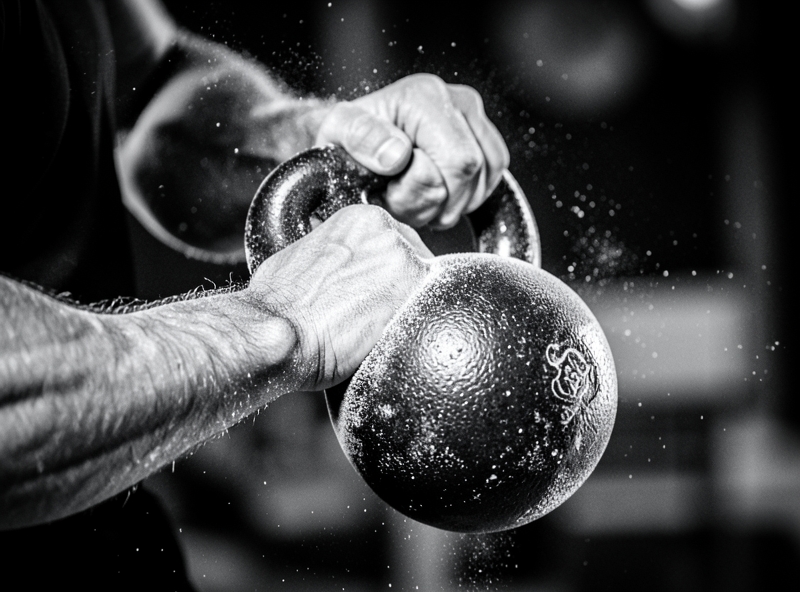
To achieve this fluidity, practitioners must put their ego aside. Remember: technique comes first, load follows. Before thinking about moving up from a 16kg bell to a 24kg bell, ask yourself if you have truly mastered your breathing, core bracing, and explosive hip drive. When you patiently refine the smallest movements, your body will naturally respond with a solid, flexible musculoskeletal system that leaves no room for injury.
| Comparison Criteria | Focus on Technique (Expert) | Chasing Weight (Amateur) |
|---|---|---|
| Muscle Efficiency | Maximizes posterior chain activation, increases endurance and flexibility. | Easily overloads shoulders and lower back, low muscle activation efficiency. |
| Injury Rate | Almost zero, improves daily posture. | Extremely high, especially herniated discs and shoulder muscle tears. |
| Movement Benefits | Increases hip joint mobility and spinal stability. | Stiff movements, loss of control over the kettlebell's inertia. |
The Kettlebell is a strict but fair teacher. It immediately punishes those who rush, and worthy rewards only go to those who know how to respect every movement. Start from the most basic things, patiently build up every single session with proper form, and you will possess a body that is not only strong but also extremely flexible and resilient over time.