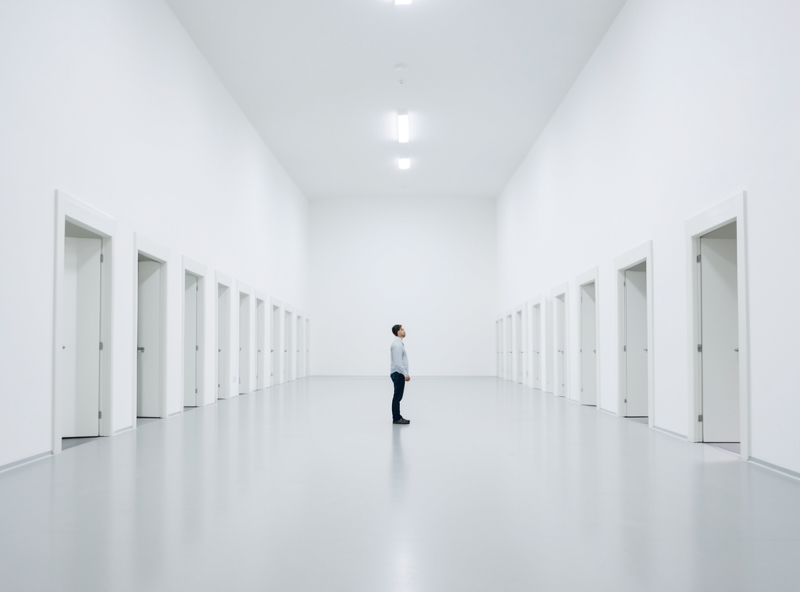
1. Introduction to the "Paradox of Choice" in the Modern Era
How long does it take you to choose a movie on Netflix before deciding to turn off the TV and go to bed in frustration? Have you ever scrolled endlessly through hundreds of product pages on e-commerce platforms, added items to your cart, and then left without buying anything? Or in your career path, is standing in front of thousands of "promising" crossroads keeping you stuck in place for fear of making the wrong choice?
We live in an era where freedom of choice is revered as the pinnacle of happiness. However, reality is proving the opposite: the abundance of choice is silently destroying our mental health. This is not a temporary emotional state, but a classic behavioral psychology phenomenon called: "The Paradox of Choice".

Defined and widely popularized by American psychologist Barry Schwartz in 2004, this theory shattered the traditional economic dogma which held that: "The more choices people have, the more freedom they have; the more freedom, the happier they are." Barry Schwartz pointed out the core paradox: when the number of choices exceeds a certain threshold, it no longer brings freedom, but transforms into a psychological shackle.
"Freedom of choice no longer brings liberation, but it brings paralysis. And even if we overcome paralysis to make a decision, we still feel less satisfied than when we had fewer choices."
To understand why maximum freedom leads to maximum mental pressure, let's analyze how the brain operates in the face of massive information flows through the comparison table below:
| Impact Factor | Expectation of Variety | Psychological Reality Suffered |
|---|---|---|
| Decision-making capability | Quickly finding the most optimal solution. | Decision Paralysis: The brain is overloaded with information, leading to procrastination or not making any decision at all. |
| Opportunity cost | Satisfied with the chosen option because it has been carefully considered. | Anticipated Regret: Constantly agonizing over better options that were passed up, reducing the value of the current choice. |
| Expectation level | Variety helps elevate the quality of experience. | Escalated Expectations: When there are too many options, we demand absolute perfection in the results. Disappointment arises at the slightest flaw. |
| Attribution of responsibility | If the result is not good, it is due to objective circumstances. | Self-blame: When there is only one choice, the fault lies with the world. When there are tens of thousands of choices, failure is entirely your own fault for choosing poorly. |
The pain of modern humans lies not in scarcity, but in the pressure to optimize every decision. We don't just want a good phone, we want the best phone within our budget. We don't just want a stable job, we want a career that is high-paying, free, and aligns with our passion. It is this "maximizing" mindset, combined with the endless flow of information from the internet, that is pushing the digital generation into a state of chronic fatigue, anxiety, and decreased satisfaction with current life.
2. Psychological Mechanism: Why Too Many Options Lead to Paralysis and Exhaustion?
Recall the last time you scrolled through Netflix for 45 minutes only to... turn off the TV and go to sleep, or stood frozen in front of a supermarket shelf with 30 different types of ketchup. You weren't being lazy. You were the victim of a defensive strike from your own brain. When faced with too many choices, the human psyche does not feel free; instead, it falls into a state of cognitive overload. This mechanism is driven by two ruthless psychological engines: Decision Paralysis and Opportunity Cost.
Decision Paralysis – When the Brain "Shuts Down"
From an evolutionary perspective, the human brain is designed to conserve maximum energy. Every decision made, whether as small as choosing breakfast or as large as signing a contract, consumes a certain amount of glucose. When the number of options exceeds the optimal processing limit (usually between 3 and 5 choices), the brain's analytical system becomes overloaded.
Instead of making a smarter decision, we get stuck in an endless loop of comparing attributes. This phenomenon is called decision paralysis. The fear of making the wrong choice is so great that the brain decides on the safest option: doing nothing. This is why complex sales funnels with dozens of upgrade options often have significantly lower conversion rates than a single purchase button.

Opportunity Cost – The Tragedy of Anticipated Regret
The real pain of having many choices does not lie in the moment of decision, but immediately after. In behavioral economics, opportunity cost is the value of the best alternative foregone. Psychologically, this creates a cruel phenomenon: anticipated regret.
When you choose Option A, you don't just enjoy the benefits of A. Your mind immediately and automatically aggregates all the superior features of Options B, C, and D and contrasts them with what you have. You feel a sense of loss even before actually experiencing the product. This regret eats away at your satisfaction, leaving you constantly wondering: "Would that other option have been better?".
"Having too many choices does not liberate us, it imprisons us in infinite assumptions of what we have missed."
| Comparison Metric | Few Options Category (3 - 5 options) | Many Options Category (> 10 options) |
|---|---|---|
| Decision-making speed | Fast, based on intuition and core needs. | Slow, easily delayed or resulting in cart abandonment. |
| Post-purchase satisfaction | High, little thought given to bypassed options. | Low, constantly doubting and backward-comparing. |
| Mental energy consumed | Minimal, keeping the mind relaxed. | Maximal, causing a state of decision fatigue. |
Understanding this mechanism, master experience designers and marketers never display everything they have. They act as filters. By limiting the number of choices, restructuring product categories, and offering personalized recommendations, they free customers from the psychological burden, transforming the shopping journey from a mental torture into a seamless and satisfying experience.
3. Escalating Expectations and the Trap of Perfection
Let's be honest with ourselves: How many times have you wasted an entire hour just trying to choose a movie on Netflix, only to end up turning off the TV and going to bed in frustration? Or scrolled through dozens of recruitment apps and hundreds of candidate profiles, yet still hesitated to click the approve button because you thought "there is still a better choice ahead"?
The modern economy is distributing a dangerous illusion: Abundance means freedom. But from a behavioral psychology perspective, the explosion of choices is silently triggering a self-destructive mechanism called "Escalating Expectations". When the world only had 2 models of phones, you only needed one that made good calls. But when the market has 200 models of phones with all kinds of specifications, you start demanding a device that must be slim and lightweight, have long battery life, a 100x zoom camera, and a reasonable price. You are no longer looking for a useful tool; you are demanding an absolutely perfect result.

In applied psychology, researchers divide humanity into two distinct behavioral groups when facing life decisions: Maximizers and Satisficers. The gap between these two groups is the boundary between peace of mind and the deep abyss of persistent anxiety.
| Comparison Criteria | Maximizer | Satisficer |
|---|---|---|
| Decision Goal | Must find the absolute best choice at all costs. | Looks for a good enough option that meets core established criteria. |
| Search Behavior | Constantly compares, gathers all feasible information, and prolongs decision-making time. | Stops immediately upon finding an option that surpasses the minimum standard threshold. |
| Post-Purchase State | Always wonders "Would that other option have been better?" and falls into regret. | Satisfied with the decision, quickly shifts focus to other matters. |
| Mental Health | Easily exhausted, prone to self-blame, and faces a high risk of depression. | High happiness index, rapid mental self-recovery capacity. |
Why are Maximizers the most tragic victims of the information explosion era? The answer lies in the Attribution Style.
When the world has few choices, if you buy a bad product or choose the wrong job, you have the right to blame external circumstances: "The market only offered this, I had no other choice." At this point, your ego is safely protected.
But when the world lays out tens of thousands of paths before you, the power of initiative belongs entirely to you. If the final outcome is not as expected, you can no longer blame the circumstances. The entire spearhead of responsibility now turns 180 degrees, pointing directly at your own competence:
"If there are hundreds of better opportunities out there and I still chose wrong, then it is entirely because I am foolish, incompetent, and weak."
This self-blame acts as an acid eroding self-esteem. Maximizers do not just regret the lost opportunity (Opportunity Cost), they are also gnawed by a sense of learned helplessness. They fall into a pathological loop: Excessive expectations -> Exhaustion from choosing -> Disappointment due to reality not matching dreams -> Self-punishment with negative thoughts. This is the fertile ground nurturing the depression of the new era, where people do not suffer from scarcity, but go mad because they have too many choices yet cannot find perfection.
4. The Art of Decision Minimalism to Reclaim Satisfaction
Every day, you waste an average of 3 hours just hesitating among dozens of trivial choices. From what to eat this morning, what to wear, to which management software to use for your new project. As a result, you fall into a state of analysis paralysis and drain your energy before even starting the actual work. Psychological science calls this the "Paradox of Choice" – the more options you have, the lower your level of satisfaction drops.
To free yourself from this subtle trap, you need to proactively restructure how your brain makes decisions using the 4 applied psychology solutions below.
| Behavioral Traits | Maximizer | Satisficer |
|---|---|---|
| Decision Goal | Search for the absolute best option. | Search for a "good enough" option that meets established standards. |
| Time & Energy | Consumes too much, leading to fatigue and procrastination. | Makes decisions quickly, optimizing energy. |
| Post-choice Psychological State | Always doubting, filled with regret, easily falls into FOMO. | Satisfied, focused on exploiting practical value. |
Apply "Satisficing" Thinking to Prevent Burnout
Research by Nobel laureate economist Herbert Simon indicates that people who tend to seek absolute perfection (Maximizers) always experience lower levels of happiness than those who are satisfied with "good enough" choices (Satisficers). Instead of trying to scour all the data on the Internet to find the best laptop in the universe, set a strict set of criteria before searching. For example: Budget under $1,000, 16GB RAM, weight under 1.5kg. The first device you encounter that meets these 3 criteria is your final choice. Stop searching immediately.
Proactively Tighten Choice Boundaries with the "Rule of 3"
The human brain is not designed to process more than 5 streams of information at the same time while maintaining clarity. When faced with too many options, actively discard all of them and keep exactly the 3 best options. The Rule of 3 forces you to filter out noise, compelling the brain to focus on deep comparison rather than broad comparison. This helps speed up decision-making by up to 3 times and minimizes post-choice regret.

Establish Fixed Routines to Free Up Brain Bandwidth
Why did Steve Jobs only wear black turtlenecks, or Mark Zuckerberg always appear in his familiar gray t-shirt? The answer lies in preserving willpower (preventing willpower depletion). Every small decision during the day consumes a certain amount of the brain's glucose. Automate your life by building fixed routines: Set a fixed meal menu for each day of the week, outline a morning routine, or prepare your outfit the night before. When trivial tasks are delegated to the subconscious mind to handle automatically, you can reserve your full mental sharpness for strategic decisions.
Learn to "Close the Window" and Appreciate the Chosen Decision
"Satisfaction does not come from having the best choice, but from committing to making that choice the best."
The greatest misfortune of modern people is the habit of thinking "the grass is always greener on the other side of the fence." Once a decision is made, proactively close all search windows related to the discarded options. Do not continue reading reviews about the phone you did not buy, nor compare your current partner with old profiles. Put 100% of your energy into exploiting and optimizing your current choice. Absolute commitment is the golden key to sustainable satisfaction in applied psychology.
5. Conclusion
Every day, your brain has to make about 35,000 decisions, big and small. From choosing a shirt, scrolling through hundreds of dishes on a delivery app, to considering a career-changing investment. We are surrounded by the illusion that: The more choices we have, the freer we are. But behavioral psychology has proven the opposite. The abundance of information and endless opportunities out there do not bring happiness; they are quietly draining your mental energy through "decision paralysis" and eating regret.
True freedom does not lie in the number of bullet points on a checklist. It lies in the ability to control your mental filter and the capacity to be satisfied with what you have chosen. Only when you know how to close unnecessary side doors will you have enough peace of mind to walk firmly on the main path.
"The ultimate art of applied psychology is not to help you grab more opportunities, but to equip you with the courage to reject things that are flashy but worthless."
To survive and thrive in this era of information overload, building a satisficing lifestyle – instead of trying to optimize everything (maximizing) – is the master key to protecting your mental health:
- Establish an absolute priority filter: Clearly define 3 core values that govern all your decisions to immediately eliminate 90% of the surrounding distractions.
- Accept "good enough": Stop searching for the absolute perfect option. A "good enough" decision made quickly always yields higher efficiency than a perfect decision delayed indefinitely.
- Periodic digital detox: Actively disconnect from sensational news sources and social media feeds that constantly trigger the fear of missing out (FOMO).

| Criteria | Maximizer Mindset | Satisficer Mindset |
|---|---|---|
| Decision Goal | Seek the absolute best option at all costs. | Seek an option that just meets the established standards. |
| Psychological State | Anxious, exhausted, prone to regret after choosing. | At peace, confident, focused on the actual experience. |
| Life Efficiency | Frequently falls into procrastination due to information overload. | Acts quickly, optimizes energy for important work. |
Return your mind to its original function: to think and create, not to hold trivial worries. By applying behavioral psychology to shape your lifestyle, you not only protect your own energy but also open the door to true freedom – where you master your choices, instead of letting choices master your life.