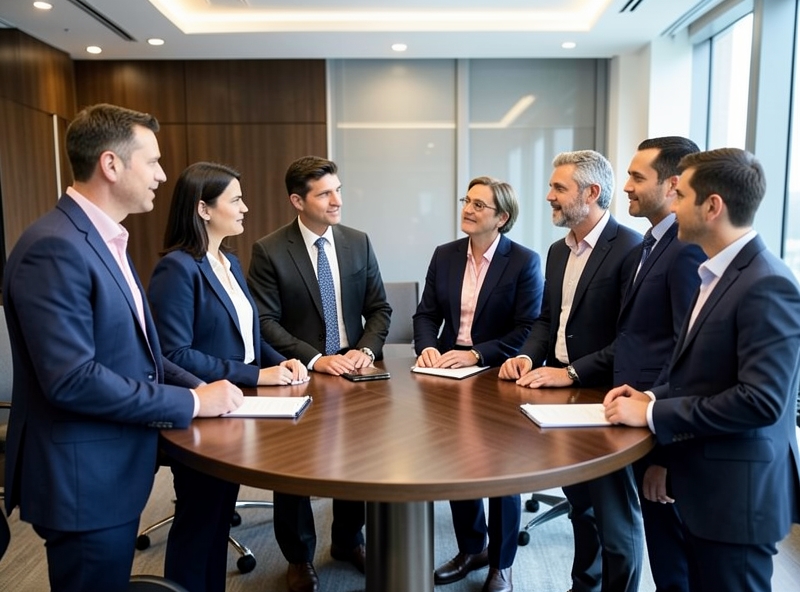
1. Overview of group conflict and the power of win-win thinking
In the academic mindset of modern management, workplace conflict is not viewed as a systemic failure, but rather as an inevitable consequence of interaction between individuals with different knowledge backgrounds, value systems, and personal goals. According to organizational behavior theory, when resources (time, budget, human resources) become finite, the confrontation between different lines of thought is a structural phenomenon. Conflict, if managed through an objective lens, is an indicator of diversity and a prerequisite for breakthroughs in creative thinking.

The "Win-Win" philosophy, rooted in game theory and widely popularized in negotiation research, serves as a strategic reference frame for transforming conflict. Instead of approaching conflict with a "zero-sum game" mindset—where one party's gain is another's loss—Win-Win thinking directs stakeholders toward finding a new equilibrium. There, solutions are established based on the synergy of interests, turning direct confrontation into interdisciplinary collaboration to increase the overall value for the organization.
"Functional conflict supports group goals and improves performance; conversely, dysfunctional conflict hinders performance and causes structural fractures." — A principle in modern human resource management.
| Comparison Characteristics | Confrontational Mindset (Win-Lose) | Win-Win Mindset (Win-Win) |
|---|---|---|
| Core Objectives | Gaining maximum advantage for individuals/departments. | Optimizing collective interests and maintaining sustainability. |
| Communication Methods | Defensive, withholding information, one-way persuasion. | Transparency, active listening, empathy. |
| Long-term Results | Erosion of trust and fragmentation of group cohesion. | Increased engagement and fostering innovation. |
To maintain cohesion within a diverse collective, prioritizing superordinate goals is an absolute requirement. When members realize that individual success is organically dependent on the system's success, they tend to self-adjust their behavior and lower their ego to move toward consensus. Prioritizing common goals does not overshadow individual roles; instead, it creates a psychologically safe environment where individuals can contribute their professional expertise without fear of risks from dysfunctional conflict. This is the driving force that transforms communication barriers into synergistic power, driving the sustainable development of the entire organization.
2. Identifying conflict types and barriers in teamwork
Teamwork isn't always "aesthetic" moments with chill meetings at coffee shops or "flexing" perfect results on LinkedIn. In reality, when independent personalities collide, "drama" or conflict is inevitable. However, instead of choosing to "ghost" teammates, identifying conflict types correctly will help you master the game and keep the work "vibe" at its most productive state.
| Conflict Type | Nature of the Issue | Impact on Teamwork |
|---|---|---|
| Task Conflict | Disagreement over project content, goals, or final outcomes. | Positive If managed well, it fosters creativity and critical thinking. |
| Process Conflict | Arguments over implementation methods: "Who does what?", "How is it done?". | Neutral Can easily lead to wasted time if the workflow isn't finalized early. |
| Relationship Conflict | Incompatibility in personality, attitude, or personal friction. | Negative This is a real "red flag," eroding energy and cohesion. |
Besides surface-level conflicts, "invisible" psychological barriers are what truly stop a team from reaching success. These barriers are like "bugs" in an operating system; if not fixed in time, the entire project can easily fall into a "lag" state.
"Conflict is not a sign of a failing team, but an opportunity for us to 'update' to a more professional version of ourselves."
- Ego is too large: The "Main Character" syndrome, where an individual always wants to be the center of attention, refuses to accept feedback, or insists on defending personal opinions even when they aren't optimal.
- Lack of transparency in information: Hoarding information or unclear communication leaves members in a "blurred" state, leading to misjudgments and mutual distrust.
- Differences in work styles: A "morning person" who likes to handle everything immediately clashing with a "night owl" who only thrives at midnight; or a perfectionist working with someone who prioritizes speed (fast-paced).

Understanding these barriers won't help you avoid conflict entirely, but it equips you with a more objective mindset. Instead of letting emotions lead, a professional Gen Z will view the problem through an analytical lens: "Is this a work-related conflict or is my ego too high?" Once you answer that question, you officially hold the key to resolving all troubles in teamwork.
3. The 5-Step Process for Conflict Coordination Based on Win-Win Principles
"Win-Win" (Mutually beneficial) – a term that may sound idealized to the point of being unrealistic in a world where human instinct often prioritizes winning for oneself. Most of us enter an argument with the mindset of a fighter: if you don't lose, I can't win. However, if we set aside the ego to look at pragmatic efficiency, the 5-step process below is not a "panacea" to please everyone, but a smart risk management strategy to protect your own long-term interests.
Step 1: Stay calm and objective. The instinctive reaction when attacked or facing opposing views is "fight or flight." However, in conflict coordination, letting emotions override reason is the fastest way to turn a minor dispute into a crisis of trust. Objectivity here does not mean being emotionless, but the ability to separate the people from the problem. You are handling an incident, not destroying an opponent.
Step 2: Listen empathically to find core interests. Do not confuse "silence" with "listening." Most people only stay silent to wait for their turn to speak or to find loopholes in the opponent's argument. Ask the question: "Why are they demanding that?" Behind an unreasonable request is often a fear or an unmet need. Only when you touch upon core interests (Interests) rather than sticking to positions (Positions), do you have a chance to turn the tide.
"In a successful negotiation, what is satisfied is not the forceful statements, but the silent needs behind them."

Step 3: Identify intersection points between parties. This is when the cold head of a mathematician is needed. Outline what you want and what they want. Instead of focusing on the 90% of controversial differences, use a microscope to look at the 10% of commonalities. This could be a shared goal regarding project progress, reputation with customers, or simply the desire not to take each other to court. This intersection is the foundation for building a solution.
| Characteristic | Win-Lose Resolution | Win-Win Coordination |
|---|---|---|
| Focus | Power and imposition. | Interests and sustainability. |
| Communication | Attacking, hiding information. | Transparency, active listening. |
| Result | One side feels resentful, latent conflict. | Voluntary commitment from both sides. |
Step 4: Propose creative alternative solutions. If there is only option A (yours) and option B (theirs), the game will soon reach a stalemate. The soft skill in this step lies in "expanding the pie" before dividing it. Is there any option C that uses the resources of both to create greater value? Creativity in conflict coordination is not about making things up, but about restructuring resources so that both sides feel they "profit" in some aspect.
Step 5: Agree on actions toward a common goal. All coordination efforts will be meaningless if they end with a lukewarm handshake and empty promises. A true Win-Win plan needs to be concretized in writing or clear commitments: Who does what? What is the deadline? How are results measured? When parties jointly perform small actions aimed at a large goal, skepticism will gradually be replaced by empirical trust.
Finally, do not expect this process to turn enemies into close friends immediately. The core goal of Win-Win is not forced harmony, but establishing a working mechanism where no one feels exploited and everyone is motivated to maintain cooperation.
4. Key facilitator skills in connecting personalities
You know, sometimes I feel like a facilitator is like a "perfumer." In a room full of strong personalities – some as intense as agarwood, others as sharp as citrus – if you don't know how to connect them, everything becomes a mess. Connection skills aren't about forcing everyone to be the same, but about creating a safe enough space for those identities to resonate rather than collide.
I remember once managing a project where two key members had a heated argument over a minor detail. Instead of stepping in to judge who was right or wrong, I applied the principles of Non-violent Communication. Instead of saying: "You're wasting the team's time," I chose to observe and share my feelings: "When I see us spending 30 minutes just debating the color of the logo, I feel a bit worried because the overall progress is slowing down. I really hope we can agree on a common criterion to move forward." You see, when I removed judgment and replaced it with objective observation, the other party no longer built "defensive walls."

Another secret weapon I always carry is the ability to ask open-ended questions. Instead of "Closed" questions that only allow for a Yes or No answer, try using questions that inspire cooperation. Instead of asking: "Can you do this?", try: "From your perspective, what is the most optimal way for us to resolve this bottleneck?". Questions starting with "What" or "How" always have the power to swing open closed doors of thought.
"The pinnacle of communication is not debating to win, but using emotional intelligence to shift the focus from a confrontation between egos to looking toward a common goal together."
To help you better visualize how to shift your mindset from confrontation to problem-solving, I've summarized it in the small comparison table below. This is how I often remind myself whenever the meeting atmosphere starts to get "as tense as a guitar string":
| Situation | Confrontational Mindset (Avoid) | Problem-solving Mindset (Use) |
|---|---|---|
| When a mistake occurs | "Why did you mess this up?" (Finding someone to blame) | "What happened and what can we do to fix it right now?" (Finding solutions) |
| When there's a disagreement | "Your idea isn't feasible at all." (Personal rejection) | "I understand your perspective; can we adjust it a bit to fit the current budget?" (Finding common ground) |
| When tension escalates | Trying to speak louder to overpower the other person. | Using EQ to name the emotion: "I see everyone is quite tired, shall we take a 5-minute break?" (Soothing the environment) |
My friend, a good facilitator is not the one with the loudest voice, but the one who knows when to be silent to listen to different rhythms. When you use emotional intelligence (EQ) to identify the waves of emotion surging in the room, you will know how to "cool down" heated heads. Always remember that behind a prickly personality is often a worry or a desire to be recognized. As long as you peel back that layer with sincerity, every personality can become a perfect piece of the common picture.
5. Building a Sustainable Collaborative Culture to Prevent Negative Conflict
People often talk about "company culture" as a miraculous religion that can resolve all conflicts, but in reality, most core value manifestos are only for beautifying capability profiles or posting on walls for fun. A true collaborative culture is not built with empty words, but with practical rules where rights and responsibilities are clearly defined before "egos" start to clash.
Establishing a shared value system is not about listing flowery adjectives like "Creative" or "Dedicated." It is about clearly defining: What do we prioritize when an issue occurs? If progress and quality clash, which one wins? A strong Code of Conduct must answer the toughest questions about behavioral conduct, rather than just stopping at being "happy and sociable." When team members clearly understand the boundaries of professionalism, trivial conflicts caused by misunderstandings about attitude will be automatically eliminated.
"Culture is not what you say in briefing meetings; it is how employees treat each other when the boss is not around and when the project is at a stalemate."
| Building Elements | Surface Manifestations (Prone to Failure) | Execution Essence (Sustainable) |
|---|---|---|
| Transparency | Endless meetings to "update the situation." | Data and decision-making processes are public; everyone has the right to access information relevant to their work. |
| Feedback | "Harmony-at-all-costs" feedback or personal criticism. | Feedback based on work results, constructive, and free from personal attacks. |
| Recognition | Periodically awarding "Outstanding Employee" certificates. | Specifically recognizing an individual's contribution to the collective success in a fair and timely manner. |
Transparency is often misconstrued as "knowing everything." Real transparency is when all important information flows freely and is not held back as a "power weapon" by any individual. When information is murky, false rumors arise, making it the most fertile ground for negative conflict. To prevent this, a culture of positive feedback needs to be established as a daily habit, rather than waiting until the year-end review to bring out the "grudge book" for reckoning.

Finally, do not expect dedication if you forget to recognize it. Humans, by nature, always doubt their value within a large collective. A fair recognition mechanism is not just a financial reward but a confirmation that: "I see your effort, and it matters to this collective success." When individuals feel they are an indispensable and respected link, they tend to protect the common interests of the group rather than seeking useless personal conflicts.
6. Conclusion
Imagine you and a friend both want an orange, but only one remains. If you choose to compromise, each person cuts the orange in half and receives a half – this is sharing based on "yielding." However, if you apply a win-win mindset, we will take a moment to ask: "What do you need the orange for?" If you need the peel for baking and I need the pulp for juice, we both get 100% of the value we want instead of just 50%. Win-win thinking is essentially about resource optimization, where we don't look for ways to divide the existing pie, but rather find ways to bake a larger pie for everyone.

In the art of facilitation, the leader plays the role of a conductor. A symphony orchestra has many instruments with different timbres, from the graceful violin to the deep drum. Your task is not to make everyone play the same instrument, but to keep the beat so that every individual can shine at the right time, creating a perfect harmony. To build a strong team, these core coordination messages should be kept in mind:
- Listen for empathy, not for response: Understand the "pain" or desires of the other person before offering a solution.
- Make goals transparent: When everyone looks in the same direction, minor friction along the way is easily overlooked.
- Leverage differences: See differences in personality and skills as the missing puzzle pieces, rather than the source of conflict.
- Constructive feedback: Always focus on solutions for the future instead of criticizing past mistakes.
"The strength of the team lies in each member, and the strength of each member is the team. Communication is the bridge that turns that strength into real results."
Ultimately, soft skills and communication are not psychological manipulation tactics, but sincerity trained through observation and understanding. When you master the art of facilitation, you are not just working; you are creating an environment where all resources are valued and promoted to their fullest. A strong team is not a team without conflict, but a team that knows how to use communication to turn conflict into a catalyst for growth.