1. Introduction: The Art and Science Behind Crispy, Flaky Pastry Layers
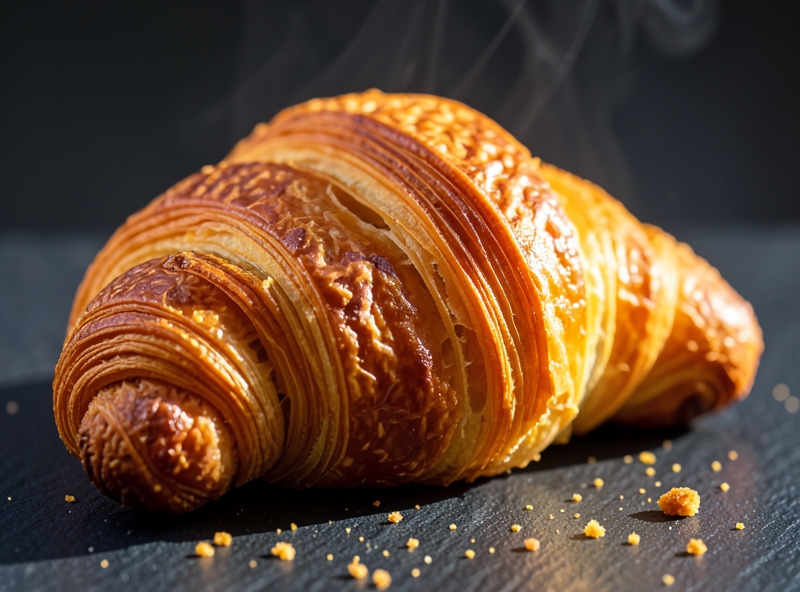
The satisfying, crispy crunch of the very first bite, followed by a buttery, melt-in-your-mouth interior—that is the ultimate experience a standard Croissant or Puff Pastry must deliver. However, behind that sensory delight lies a harsh reality: thousands of bakers fail every day with oily, flat, and gummy batches. The fine line between a crispy, flaky pastry masterpiece and a ruined block of dough isn't down to luck. It lies in lamination technique—a precise dance between structural physics and food chemistry.
Dough lamination is not merely the act of rolling and folding. It is the process of building a micro-architecture consisting of tens or hundreds of paper-thin sheets of dough alternating with corresponding thin sheets of cold butter. Without mastering the scientific principles behind this technique, every effort in the kitchen is nothing more than a game of chance.
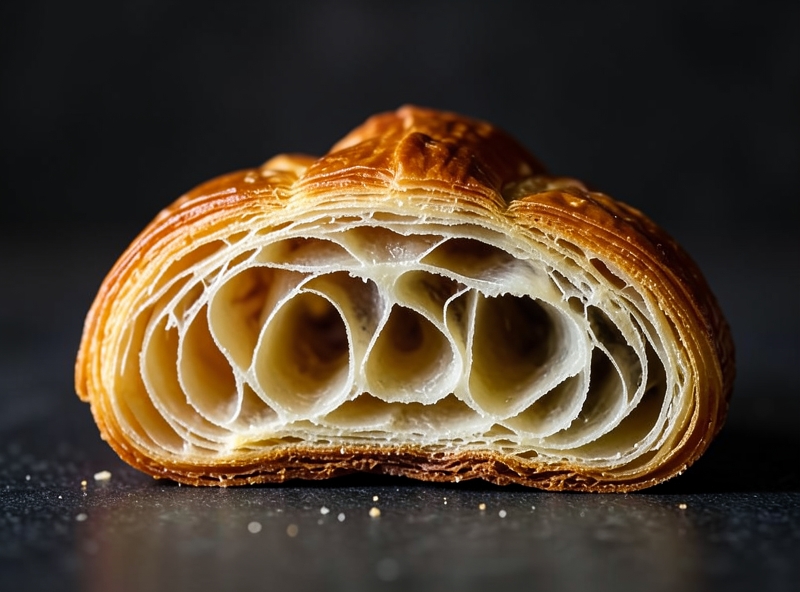
The most miraculous aspect of lamination lies in how the pastry rises in the oven. Laminated pastry does not rely on yeast or baking powder to gain volume at all. It all depends on the power of thermal expansion.
"When the baking sheet enters the high-temperature oven, the natural water content in the butter immediately evaporates, creating steam pressure that lifts the dough layer above it. Simultaneously, the fat in the butter melts, frying each individual sheet of dough until crispy before the crumb even sets."
To fully control this chain reaction, the baker must master the "Golden Triangle," consisting of three vital elements:
- Flour & Gluten Matrix: You must use flour with an exact protein content (typically 11.5% - 12.5%). The goal is to build a gluten network strong enough to be rolled thin without tearing, yet pliable enough not to shrink back during rolling.
- Lamination Butter (Tournage Butter): The butter used must have a fat content of 82% to 84%. High-water butter will make the dough soggy, break the layers, and result in a gummy texture.
- Temperature - The Fatal Variable: The ideal temperature range for butter to achieve a plasticity matching the dough is 16°C - 18°C. If it is too cold, the butter will shatter into broken fragments inside the dough. If it is too warm, the butter will melt, absorbing into the dough layers and turning the entire mass into a greasy mess.
| Butter & Dough State | Phenomenon During Rolling | Result After Baking |
|---|---|---|
| Butter too cold (< 14°C) | Butter shatters under the rolling pin, tearing through dough layers. | Pastry rises unevenly, leaks steam, and results in a dense, crumbly interior. |
| Butter too soft (> 20°C) | Butter melts and blends completely into the dough (loss of lamination). | Pastry fails to rise into layers, leaks butter onto the baking sheet, resulting in a soggy, greasy structure. |
| Optimal temperature (16°C - 18°C) | Butter is pliable like clay, spreading evenly in parallel with the dough sheet. | Pastry rises 3–4 times higher, with crisp, distinct layers and a beautiful honeycomb interior. |
Mastering the interaction between Flour, Butter, and Temperature is the defining step between an amateur baker and a world-class Pastry chef. Once you understand the physical principles behind every single fold, you will not only control flavor, but also confidently create the most extraordinary pastry structures.
2. Butter Temperature: The "Golden Key" to Success or Failure
Have you ever spent hours meticulously rolling and folding laminated dough, only to end up with a dense, greasy, and flat final product? That painful failure rarely stems from the flour recipe; rather, it comes from turning your butter block into a "killer" that destroys the pastry structure. In lamination techniques, butter is not merely a flavor ingredient; it is a **temporary mechanical structure**.
Butter is a water-in-oil emulsion consisting of about 80-82% fat and 16-18% water. The goal of lamination is to flatten the butter into dozens of paper-thin layers perfectly alternated between layers of dough (détrempe). When baked at high temperatures, the water in the butter evaporates, creating an upward force that separates the dough layers, while the fat keeps the dough sheets from sticking together. If the physical state of the butter is disrupted, this entire mechanical structure will collapse immediately.
| Butter State | Physical Phenomena During Rolling | Consequences on Pastry Structure |
|---|---|---|
| Butter too hard (< 15°C) | Loses plasticity, shattering into sharp fragments under the pressure of the rolling pin. | Butter fragments pierce and tear the gluten network, **tearing the dough**. During baking, steam escapes through these tears, preventing the pastry from rising and becoming flaky. |
| Ideal butter (15°C - 19°C) | Achieves perfect plasticity. The butter deforms and stretches uniformly with the movement of rolling the dough. | Creates dozens of parallel, perfectly separated butter-dough layers. The pastry rises with distinct flakiness and a perfect honeycomb interior structure. |
| Butter too soft (> 19°C) | The melting point of the fat is reached, causing the butter to lose its ability to support the structure. | Butter becomes sticky, **soaking into and blending with the dough**. The laminated structure disappears completely, turning the croissant into a rich but dense brioche-like bread. |
"In the world of high-end pastry, controlling butter is not just cooking; it is thermodynamic science. A 2°C deviation is enough to distinguish between a flaky masterpiece and an expensive lump of wasted dough."
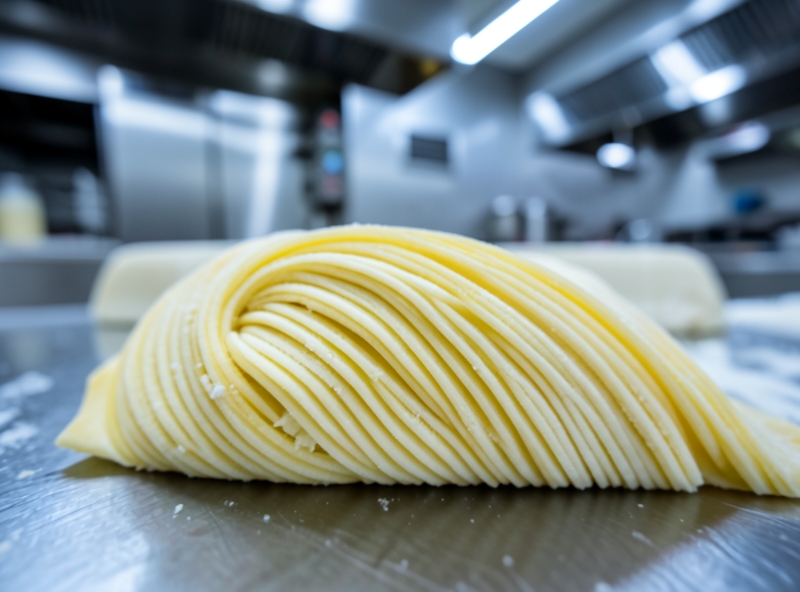
The "golden" temperature range recognized by master chefs lies between **15°C and 19°C** (depending on the melting point of high-fat animal butter ranging from 82-84% fat). At this temperature range, the butter achieves a plasticity equivalent to that of the rested dough block (détrempe). This is the principle of **consistency matching** – if either component is harder or softer than the other, the lamination technique will fail.
How can you master and control this strict temperature range in a real kitchen environment? Apply these 4 professional temperature control techniques below:
- "Fingerprint Test" Technique: Instead of relying solely on an infrared thermometer, gently press your finger onto the butter block. Ideal butter at 15°C - 17°C will **leave a light indentation without sticking to your hand**, and the butter block can be bent slightly without snapping.
- Temperature Synchronization Rule (Détrempe vs Butter): The rested dough block (détrempe) must always be **2°C to 3°C colder than the butter block** (around 12°C - 14°C) before enclosing the butter. Because the dough has a higher water density, it absorbs heat faster when handled on the worktop.
- Closed-loop "Roll - Rest" Time Management: Each rolling and folding session should not exceed **2 minutes**. Immediately after completing a turn (single or double fold), wrap the dough in plastic wrap and put it in the refrigerator (2°C - 4°C) to rest for at least **30 - 45 minutes** to cool the butter and relax the gluten network.
- Workspace Environment Control: The ideal kitchen ambient temperature for rolling dough is **18°C - 20°C**. If your kitchen is warmer, cool down the countertop with gel ice packs before rolling out the dough.
3. Lamination Technique: The Mathematical Method Behind Hundreds of Butter Layers
Why does your croissant turn into a dense, greasy loaf instead of achieving a proper honeycomb interior? The answer lies in **temperature physics and fold geometry**. The lamination technique (folding butter dough) is not an improvisation, but a process of building hundreds of alternating dough and butter layers measured in micrometers. A deviation of just $1^\circ\text{C}$ or an off-angle roll can cause the mechanical structure to collapse instantly: the butter snaps and tears the dough, or melts and leaks back into the dough.
To master this technique completely, understanding the mathematical nature of each fold is essential:
- Single Fold (Letter Fold - 1 into 3): The dough sheet is divided into 3 equal parts; the right section is folded over the middle third, and then the left section is folded over the top like a letter. This method **triples the number of butter layers**. If starting with 1 butter block encased between 2 layers of dough, after 3 consecutive single folds, the mathematical calculation $3^3$ will yield precisely **27 layers of butter** alternating between 28 layers of dough.
- Double Fold (Book Fold - 1 into 4): The two outer edges of the dough sheet are folded to meet at the central crease, then the entire dough block is folded in half like closing a book. This technique **quadruples the number of butter layers**. A double fold provides higher mechanical compression, resulting in a sturdier structure that increases resistance to steam lift during baking.
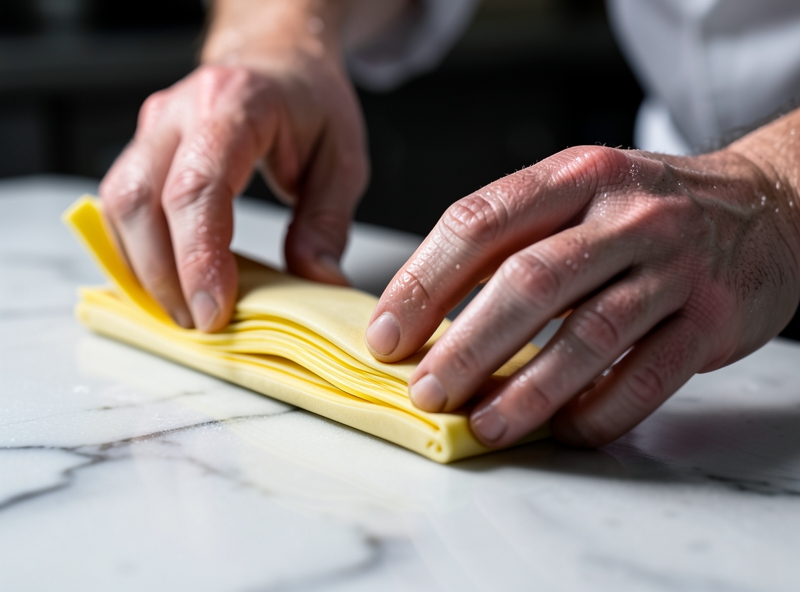
Many people mistakenly assume that all laminated pastries have the same structure. The core difference between **Croissants (leavened laminated dough)** and **Puff Pastry (unleavened laminated dough)** directly determines both the folding technique and the final crumb structure:
| Comparison Criteria | Croissant (Pâte Levée Feuilletée) | Puff Pastry (Pâte Feuilletée) |
|---|---|---|
| Leavening Mechanism | Combination of **$CO_2$ gas (from yeast)** and steam lift from the butter. | Purely relies on sudden **steam power** during baking. |
| Optimal Butter Layers | 12 - 27 butter layers (Typically 1 double fold + 1 single fold, or 3 single folds). | 243 - 729 butter layers (Typically 5 to 6 single folds). |
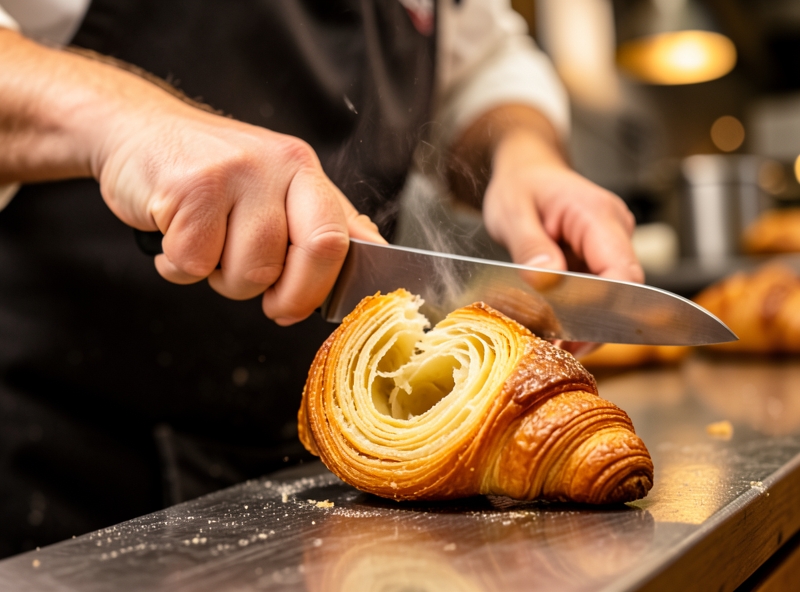
| Crumb Structure | **Honeycomb** network with large air pockets, elastic membranes, light and airy texture. | **Flaky** structure exploding into delicate, thin layers like stacked dry leaves. |
| Rolling Pressure Control | Gentle pressure to avoid collapsing developing yeast air pockets inside the dough. | Even compression, rolling as thin as possible to create hundreds of ultra-fine layers. |
"Lamination is not a race to create as many layers as possible. It is the art of maintaining absolute balance between the ductility of gluten and the thermal elasticity of fat."
The secret to completely solving butter leakage is the **Plastification State (butter plasticity)**. The butter and dough must achieve similar mechanical firmness at the ideal temperature range of $14^\circ\text{C} - 16^\circ\text{C}$. If the butter is too cold, it will shatter into small pieces inside the dough. If the butter is too soft, it will blend completely into the dough, destroying layer separation and turning an expensive bake into a greasy, dense lump.
When laminating croissants, over-folding ($>36$ butter layers) makes the butter layers excessively thin. Under oven heat, paper-thin butter gets absorbed back into the dough before it can evaporate to push the dough open, completely ruining the coveted honeycomb crumb structure.
4. Oven Spring Mechanism: Steam Evaporation and Structural Crisping Process
Why does your puff pastry turn into an oil-soaked, gummy mass instead of proudly expanding into hundreds of paper-thin layers? The answer lies not in luck, but in a second-by-second precise physical-chemical reaction inside the oven. The moment the baking tray hits high heat, a "structural breakthrough" occurs, turning the combination of butter and dough into a crisp masterpiece.
Understanding this mechanism is the boundary defining an amateur baker from a true professional. This process occurs through two parallel, closely interacting stages:
- Stage 1: The Steam Engine Effect – Standard butter contains about 16% to 18% water. When the oven temperature reaches 190°C to 210°C, this water immediately boils and turns into steam. The core principle: Steam expands to 1,600 times the volume of the original water. Being trapped between pliable gluten layers, the steam pressure surges, forcibly separating and puffing up each thin layer of dough.
- Stage 2: Intra-layer Frying – As water evaporates, the remaining pure fat in the butter melts completely. This fat permeates the two surfaces of the thin dough layers, executing a "miniature deep-frying process" right inside the pastry structure. As a result, the dough layers do not stick back together, while achieving extreme dryness and crispness.
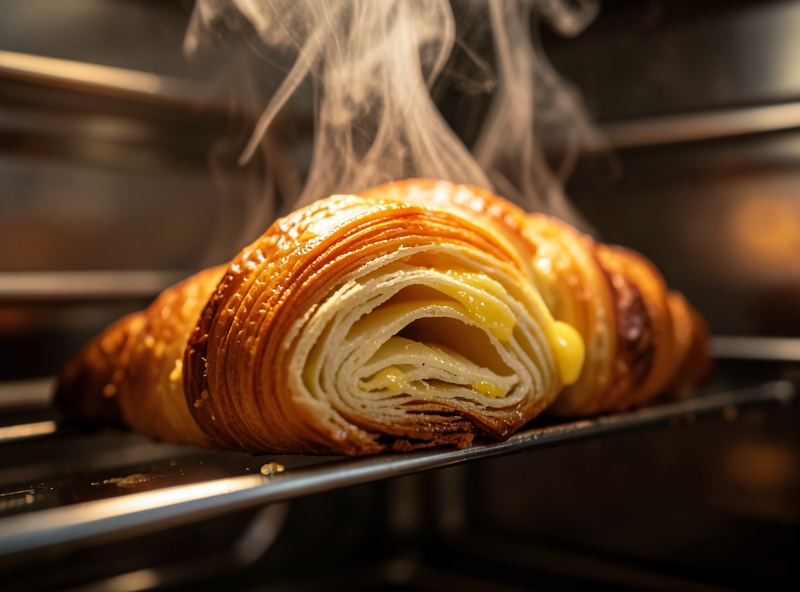
If the oven temperature is not high enough, the butter melts and leaks out before the water can evaporate. As a result, the pastry loses structure, becomes tough and greasy. Conversely, with the accurate temperature, the Maillard reaction between sugars and proteins in the flour occurs perfectly over hot fat, creating an attractive golden-brown color and a rich caramel aroma.
"Oven temperature doesn't just bake the pastry—it applies mechanical pressure. Without a thermal shock strong enough to instantly vaporize water, the multi-layered structure can never form."
Take a look at the breakdown of pastry structural changes at key temperature milestones to gain full control over your final product:
| Temperature Milestone | Physical-Chemical Phenomenon | Impact on Pastry Structure |
|---|---|---|
| 32°C - 35°C | Butter reaches its melting point. | Fat liquefies, ready to coat gluten films. |
| 100°C | Water in butter reaches boiling point, evaporating rapidly. | Generates pushing pressure, separating dough layers to lift the pastry high. |
| 140°C - 165°C | Maillard reaction and Caramelization are triggered. | The crust turns golden, releasing a signature aroma. |
| > 180°C | Gluten films set shape (Coagulation). | Crisp structure is firmly set, preventing the pastry from collapsing after cooling. |
To optimize this process, the secret lies in Thermal Shock. The dough must be kept thoroughly chilled (around 4°C - 6°C) before being transferred straight into an oven pre-heated for at least 30 minutes at 200°C. This sudden temperature difference turns the water content in butter into an instant steam "detonator," yielding maximum rise and a satisfyingly crisp crunch the moment you touch the crust.
5. Frequently Asked Questions (FAQ)
Hours of meticulous rolling and folding can vanish in a flash just minutes after the oven turns on. Making pastry leaves no room for luck; it is a precise science of temperature, moisture, and protein structure. Below is an in-depth technical breakdown to effectively solve the most frustrating issues in the pastry kitchen.
Q1: Why does butter leak onto the tray during baking (Butter Leakage)?
The "butter pool" phenomenon on the baking sheet results in a dense, heavy pastry that fails to achieve a light, flaky lamination. This issue stems from three core technical causes:
- Oven temperature is too low: If the temperature is below 190°C - 200°C during the first 5 minutes, the butter will reach its melting point before the starch and gluten matrix can set to form a structure that traps steam. Liquid butter escapes instead of generating steam lift.
- Lamination structure is ruined: During rolling, if the butter is too hard and fractures, or too soft and bleeds into the dough, the layering effect is lost. Misplaced butter escapes directly when exposed to heat.
- Under-proofing: Dough that hasn't fully expanded creates excessive internal pressure when exposed to high heat, pushing liquid butter out through the dough walls before the structure can set.
"Golden Rule: The temperature of the butter block and the dough must always achieve perfect parity (ideally between 12°C - 15°C) throughout the rolling process."
Q2: How to handle elastic dough that keeps snapping back and resists rolling thin?
Dough that fights back and snaps back like a rubber band indicates that the gluten network is over-stressed due to excessive kneading or rolling. Continuing to apply heavy pressure will tear the internal butter layers.
Technical solution: Wrap the dough tightly in plastic wrap and let it rest in the refrigerator for 20 - 30 minutes. The cold temperature relaxes the protein bonds while restoring plasticity to the butter. When rolling again, use gentle pressure extending from the center to the four corners, never pressing down forcefully from above.
Q3: Which type of butter and what fat content (%) should be chosen for the best pastry quality?
The type of butter you choose determines up to 80% of the success of a flaky structure and signature flavor. The water content in butter is the indirect "enemy" that causes soggy dough and ruined layers.
| Butter Type | Fat Content (%) | Water Content (%) | Pastry Performance Rating |
|---|---|---|---|
| Margarine | 70% - 75% | > 20% | Not recommended: Artificial flavor, leaves a greasy film on the palate, poor natural flakiness. |
| Standard Butter (Table Butter) | 80% - 82% | 16% - 18% | Acceptable: Melts easily at room temperature, requires extremely fast handling and constant chilling. |
| Dry Butter / Beurre de Tourage | 84% - 89% | < 14% | Gold Standard: High melting point (34°C - 38°C), flexible plasticity, creates paper-thin layers without fracturing. |
The gold standard for professional pastry is butter with a fat content of 82% or higher, ideally 84% (Dry Butter). The less water in the butter, the more steam evaporation focuses on pushing up the dough structure, yielding perfect flaky lamination along with a rich, authentic flavor.