
1. Overview of Decision Fatigue and Its Impact on Discipline
On the trails through the Andes or in the vibrant markets of Marrakech, I realized that human survival relies not only on muscle strength but also on the ability to navigate through countless choices. In modern psychology, this phenomenon is called "Decision Fatigue." This is a state of declining quality in the decisions made by an individual after a long sequence of continuous choices. Like a traveler exhausted of water reserves after a long day crossing the desert, our minds also possess a finite capacity of mental energy for each day we wake up.
"Every choice we make, from choosing a brocade shawl to deciding on a direction on a map, is a consumption of 'willpower units.' When this energy bank hits rock bottom, instinct will rise to replace reason."
Viewed from an anthropological perspective, our ancestors lived in social structures with few variables, where rituals and traditional customs framed most daily decisions. In contrast, modern humans face a "sea" of choices from dawn until late at night. The "Ego Depletion" theory explains that willpower is not an eternal moral quality, but a limited biological resource, similar to the energy in muscle groups. When you force yourself to choose too much, the "willpower muscle" becomes fatigued, leading to a tendency to seek the easiest escapes or postpone all actions.

The link between mental energy depletion and the breakdown of personal discipline is a harsh straight line. Discipline requires supreme control by the prefrontal cortex—the organ that manages complex functions. When decision fatigue takes over, this brain region gives way to the limbic system—the realm of immediate desires and the instinct for gratification. This is exactly why, after a stressful day at work with hundreds of emails and meetings, we easily give up going to the gym to choose to lie on the sofa, or break our diet with a greasy fast-food meal.
| Energy State | Manifestation of Discipline | Response Mechanism |
|---|---|---|
| Abundant (Morning) | Strict, adhering to the set roadmap. | Reason leads, easily resisting temptation. |
| Declining (Late Afternoon) | Loose, procrastination begins to appear. | Prioritizing tasks that require the least effort. |
| Depleted (Night) | Breaking personal commitments. | Instinct takes complete control. |
Understanding decision fatigue is not for us to give up in the face of adversity, but to learn how to "ritualize" life. Indigenous people in remote highlands often have strictly repeated habits in their daily lives. That is not merely conservatism, but an ancient wisdom that helps them save mental energy for true life-and-death moments. In the journey of self-development, identifying the finitude of willpower is the first step to establishing a sustainable discipline system, rather than relying solely on the momentary effort of willpower.
2. The Scientific Mechanism: Why Does Decision-Making Ability Decline Over Time?
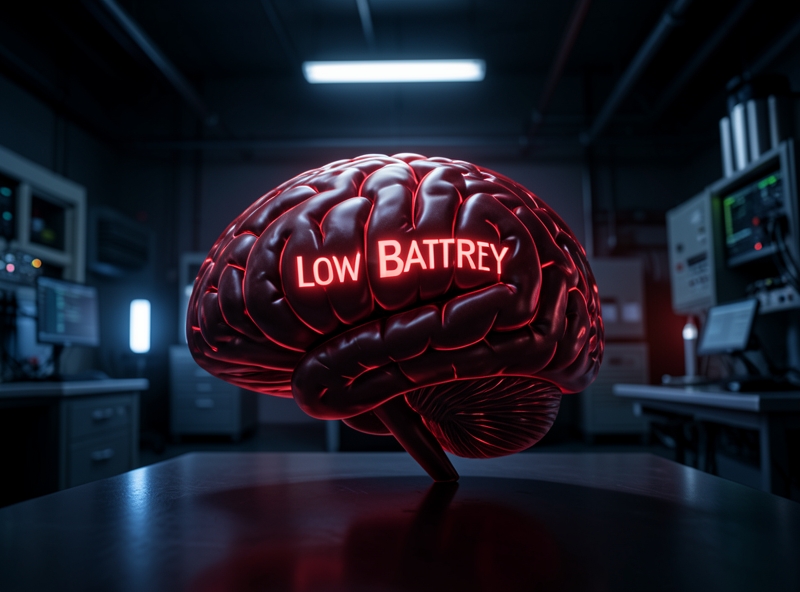
Many "motivational speakers" love to preach that willpower is an infinite resource, as long as you are "determined enough." In reality, from a neurobiological perspective, that is a sweet lie. The human brain is not a perpetual motion machine; it is more like an old smartphone – the battery drops rapidly as soon as you run heavy applications like "decision making" or "emotional regulation."
The Ego Depletion theory by psychologist Roy Baumeister indicates that willpower is a finite resource. Every time you have to choose between eating a salad or fast food, between waking up to exercise or sleeping in, you are consuming a certain amount of "mental energy." When this fund is depleted, your self-control will collapse, regardless of how many self-help books you have read.
"Willpower is not a skill, it is a biological resource. Do not force a brain starved of energy to make life-altering decisions."
Physically, the Prefrontal Cortex – the "executive center" responsible for logical thinking and impulse control – is a part that consumes an enormous amount of energy (glucose). When you constantly have to process choices from morning to afternoon, the glucose reserves for these high-level neural activities decrease. The brain, with a survival instinct prioritizing energy conservation, will begin to "cut the budget" by switching to autopilot mode or making the least effortful choices.
How do you know if you are falling into a state of "decision fatigue" rather than innate laziness? Examine yourself through the following practical signs:
| Signs to Recognize | Practical Manifestations | Consequences |
|---|---|---|
| Procrastination | Hesitating before important tasks, getting lost in useless social media scrolling. | The brain is avoiding spending more energy on difficult choices. |
| Impulsive Choices | Overspending at the end of the day or binge eating after work. | The impulse control "barrier" in the prefrontal cortex has been lowered. |
| Avoidance of Responsibility | Answering "whatever" or letting others decide for you. | Paralysis of analytical ability due to input data overload. |
The truth is, the later it gets in the day, the higher the chance you will make a bad decision. People who are sharp are not those with more iron willpower than others, but those who know how to structure their lives so they don't have to use willpower too much. They understand that instead of trying to "force" themselves against decision fatigue, the smarter way is to protect their precious energy resources while they are still full.
- Impulsivity: Why do supermarkets always place candy and snacks at the checkout counter? Because after a period of agonizing over food choices, customers are too exhausted to say "no" to a chocolate bar.
- Compromise: Judges tend to give harsher rulings when they are hungry or tired, simply because reviewing a pardon requires more analytical energy than maintaining the status quo.
Accepting this biological mechanism is not about finding an excuse for indulgence, but the first step in building a self-development strategy based on practical science, rather than illusions of boundless mental strength.
3. Simplification Strategy: Reducing Unnecessary Decisions
Research from Cornell University indicates that the average adult makes approximately 35,000 decisions every day. The "Decision Fatigue" effect diminishes the quality of choices and consumes significant mental energy. To optimize personal performance, minimizing the number of variables to process is a mandatory requirement, not an option.
| Comparison Metric | Before Simplification | After Simplification | Performance Improvement |
|---|---|---|---|
| Morning Preparation Time | 45 - 60 minutes | 15 minutes | ~70% |
| Willpower Consumption Level | High (Continuous choices) | Low (Template execution) | Energy conservation |
| Procrastination Probability | 25 - 30% | < 5% | Increased action capability |
Empirical data shows that establishing fixed structures helps the brain switch to "autopilot" mode, thereby allocating resources to higher strategic decisions. Below are the 3 most practical methods:
- Build Fixed Routines: Establish unchanging morning and evening schedules. For example: Wake up - Hygiene - Read for 15 minutes - Start work. Repeating these sequences of actions eliminates the question "What should I do next?".
- Simplify Daily Choices: Apply a "uniform" for work (Capsule Wardrobe) and a fixed weekly menu. Eliminating the consideration of what to wear or what to eat saves an average of 20-30 minutes per day.
- Automate Repetitive Tasks: Use digital tools to automate bill payments, email filtering, and content scheduling. Convert recurring tasks from an active state to a passive one.

"Maintaining consistency in small decisions is the foundation for preserving sharp judgment for major decisions."
Implementing a simplification strategy does not sacrifice flexibility; rather, it creates a solid framework. When unnecessary variables are eliminated, the rate of achieving daily goals increases in direct proportion to the amount of willpower preserved.
4. Optimizing Decision-Making Performance Through Energy Management
Many people still harbor the illusion that good time management alone is enough to master life. In reality, time is finite and distributed equally to both the lazy and the hardworking, but energy is not. You can spend 2 hours sitting in front of a screen at 10 PM, but what you produce is often just cognitive clutter because your brain has depleted its glucose. Decision-making ability is not a faucet that flows indefinitely; it is like a phone battery, gradually draining after every choice you make, from "what to wear today" to "should I sign this million-dollar contract."
"Decision Fatigue is the silent enemy of every self-development strategy. When energy runs out, the brain will choose the path of least resistance: procrastinating or choosing at random."
To avoid falling into the trap of false exhaustion, scheduling work according to the brain's "golden hours" is mandatory, rather than simply working based on inspiration. Neuroscience has proven that, for most people, the first 2-4 hours after waking up are when analytical and problem-solving abilities peak. This is not the time to check emails or reply to random messages on social media. Dedicate it to strategic decisions or tasks requiring Deep Work.
| Energy Status | Suitable Type of Work | Practical Example |
|---|---|---|
| Peak (Early Morning) | Important decisions, logical thinking, learning new knowledge. | Business planning, coding, learning a foreign language. |
| Average (Afternoon) | Collaboration, communication, repetitive tasks. | Team meetings, replying to emails, editing existing documents. |
| Low (Late Night) | Free creativity, entertainment, recovery. | Sketching new ideas, reading books, meditation. |
The Batching technique is also a practical tool to save brain resources. Jumping from drafting a document to answering the phone and then back to checking reports creates a "switching cost." Each time you switch, the brain takes about 15-20 minutes to regain the previous level of focus. Instead of letting yourself be fragmented by trivialities, plan similar tasks into a fixed time slot. Don't pride yourself on being a multitasker, because in reality, you are just doing many things at once superficially.

Finally, don't expect your brain to function like an industrial machine if you treat it like a dumping ground. Nutrition and rest are not rewards after work; they are inputs. A lunch too high in carbohydrates will lead to sleepiness due to a blood sugar spike, directly killing afternoon productivity. Instead, short breaks (Power Naps) of about 15 minutes or the Pomodoro technique can help reset cognitive ability more effectively than any fourth cup of coffee of the day.
Be realistic: You cannot manage the outside world, but you can absolutely manage your own "energy capital." Don't let the most important decisions of your life be made by a brain in a "low battery" state.
5. Establishing a 'Defense System' to Maintain Sustainable Discipline
During journeys through ancient forts in Rajasthan or cliff-hanging villages of the Dogon in Mali, I realized an immutable law of humanity: Survival and prosperity have never relied solely on momentary courage. They rely on the structure of fortifying walls and the meticulous calculation in the arrangement of living spaces. Similarly, personal discipline is not a fierce, never-ending internal battle, but the result of a "defense system" established to protect the mind against the waves of distraction in the digital age.
"Discipline is not self-maltreatment through willpower, but the art of arranging life so that the right choices become the easiest."
Indigenous people in the world's harshest regions always have strict rituals and rules to minimize errors driven by emotion. To build a sustainable defense system for ourselves, we need to learn how to create "behavioral architecture" through two main pillars: environment optimization and standardization of decision-making processes.
| Characteristics | Relying on Momentary Willpower | Relying on a Defense System |
|---|---|---|
| Mechanism | Forcing oneself to resist temptation. | Removing temptation from sight and mind. |
| Energy Consumption | Very high, easily leading to mental exhaustion. | Low, creating a state of automatic Flow. |
| Sustainability | Fails when in a bad mood or tired. | Sturdy regardless of emotional state. |
First, consider redesigning your living "ecosystem." Just as ancient astrologers needed a quiet void to observe the stars, you need a workspace clean of distractors. If your phone is the source of distraction, leave it in another room. If social media notifications are white noise diluting your focus, use apps to block access by the hour. When the environment is purified, the finite energy of willpower will be preserved for genuine creativity.
Second, apply decision-making support tools such as Checklists and Standard Operating Procedures (SOPs). Ancient Polynesian sailors did not set sail on intuition alone; they relied on star maps and wave signs passed down through generations. Possessing a checklist for each morning or a set of standards for choosing work helps you escape the "Decision Fatigue" trap. When everything is pre-shaped in a logical framework, discipline will no longer be a burden, but a natural rhythm of life, much like the sun always rising in the East after every long night.
- • 2-Minute Rule: If something takes less than 2 minutes, do it immediately to avoid accumulating mental clutter.
- • Establish Digital Boundaries: Only check emails and messages during fixed hours of the day.
- • Startup Ritual: A small action (like brewing tea or listening to instrumental music) to signal the brain to enter a state of deep work.
6. Conclusion
The journey of self-development is often misunderstood as an exhausting marathon where the one who pushes themselves the hardest wins. In reality, imagine your effort as the electric current in a smartphone. If you keep too many background apps open (anxieties, useless habits), the battery will drain before you can do anything important. Discipline, therefore, is not about "forcing" yourself to endure, but rather the art of being a smart "financial manager" for your own intellectual resources.
| Aspect | Common Misconception | True Essence |
|---|---|---|
| Discipline | Compulsion and self-severity. | Energy management and setting boundaries to protect goals. |
| Effort | Working as many hours as possible. | Choosing the right tasks to focus on (Doing the right things rather than just getting things done). |
| Progress | Expecting immediate results. | Small but steady accumulation, similar to compound interest. |
When you know how to turn off the "excess apps" in your mind, you will find discipline becomes much lighter. That is when you shift from a state of "having to do" to "choosing to do." Sustainable growth only happens when we stop wasting willpower on unnecessary battles and start investing it in habits that bring long-term value.

"Discipline is not a shackle, but the wings that help you fly higher by removing the excess weight of distraction."
The final piece of advice for you on this path is mindfulness in selection. Every morning when you wake up, instead of diving straight into your to-do list, take a few minutes to observe your mental "battery." Don't let trivial matters steal your clarity. Practice the ability to say "no" to good things so that you can say "yes" to great things.
- Listen to your body: Recognize when intellectual resources are depleted to rest at the right time.
- Simplify: Eliminate distractions in your living and working environment.
- Focus on the present: Every small choice right now is building the version of you tomorrow.
Remember, self-development is a process of refining yourself to become more elegant, not piling on unnecessary pressure. When you master mindfulness, discipline naturally becomes like breathing, and success will simply be the inevitable result of a smart lifestyle.