1. The Importance of Modern Feng Shui in Apartment Spaces
Let me "dissect" this for you: Modern Feng Shui is not something mystical or vague. From the perspective of a true "geek," it is actually Architecture Systems Optimization – optimizing architectural systems. We are talking about fine-tuning the Data Flow of energy, specifically photons (light) and air molecules (air). In an apartment, where the physical structure is often fixed by the building's reinforced concrete frame, establishing a spatial arrangement "algorithm" is absolutely vital.
"Modern Feng Shui is the intersection of Aerodynamics and spatial psychology, where light and air circulation serve as the core operating system."
Let's analyze the difference between the "hardware architecture" of landed houses and apartments. In a landed house, you have full control over the Input/Output (front door, back door, skylight). But with an apartment? You are living in a stacked "block" of data. Every adjustment must be based on existing parameters to create a Positive Energy Flow. Why is this so important? Because apartments often suffer from "stagnant air" due to closed hallways and limited open surfaces.
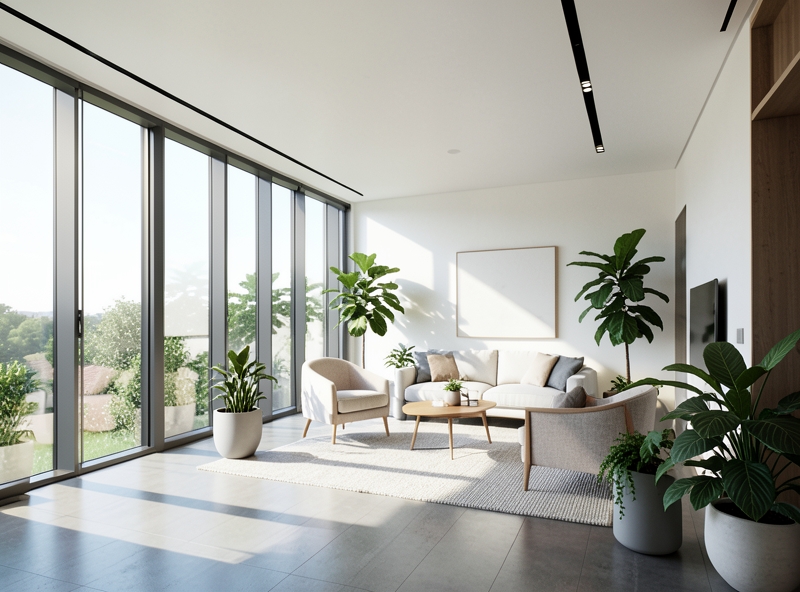
To help you visualize the "configuration difference" between these two types of housing, look at the technical comparison table below:
| Technical Specifications | Standalone House | Apartment Unit |
|---|---|---|
| Air Intake | Multi-directional (Main door, windows, garden). | Limited (Mainly from balconies and main windows). |
| Flow Rate | Easily adjusted through natural openings. | Requires intermediate "nodes" like screens or plants for redirection. |
| Luminosity | Evenly distributed from multiple sides. | High intensity concentrated on one side, prone to thermal imbalance. |
| Noise/Static | Less affected by resonance from other floors. | Directly influenced by the building's vertical structural axis. |
Adjusting Feng Shui for an apartment is essentially performing Hotfixes for the space. We use mirrors to "hack" the area, plants as a Bio-filter to clean the air, and colors as Color-codes to stimulate emotions. The ultimate goal is to transform a closed space into a living entity, where the energy flow doesn't hit a "bottleneck" but always circulates smoothly, bringing health and fortune to the owner.
- Aerodynamic Optimization: Ensuring the airflow entering from the balcony does not run straight out the main door (the "piercing heart" effect).
- Optical Balance: Using curtains or translucent partitions to regulate photon intensity, avoiding "Too Much Yang" (glare) or "Too Much Yin" (too dark).
- Logical Arrangement: Positioning furniture according to fate elements while ensuring the best UX (User Experience) for the residents.
2. Clearing Airflow at the Main Entrance and Foyer
If we consider a house as an Operating System, the main entrance and the foyer (entry hall) are the "Main Input/Output Port." This is where all energy data streams from the external environment are received. However, a very common architectural error that I often call a serious "Design Bug" is the Sha Qi (Piercing Heart Sha) error. This phenomenon occurs when the main door is aligned in a perfectly straight line with the back door or balcony, creating a "broadband transmission line" but lacking a "buffer." This causes the entire vital energy (Sheng Chi) that has just entered to immediately suffer "packet loss" to the outside, failing to circulate to other functional zones.
"In energy flow design, speed is not as important as circulation. An airflow moving too fast becomes killing energy (Sha Chi), but an intelligently directed airflow becomes vital energy (Sheng Chi)."
To optimize the "protocol" for receiving air at the entry hall, we need to deploy supporting "Hardware" to redirect the flow. Designing a technically sound foyer is not merely about aesthetics; it's about creating a "Filter" to remove impurities and reduce the airflow speed. Imagine you are building a physical "Router" right at the entrance to distribute energy evenly across all nodes in the living space network.
| Technical Solution | Operating Mechanism | Airflow Regulation Efficiency |
|---|---|---|
| Screen (Bình phong) | Creates a direct physical obstacle on the straight path of the airflow. | Prevents Piercing Heart Sha at a 95% level, forcing the airflow into an S-shape. |
| Multi-functional Cabinet | Increases material density at the "Transition point." | Stores energy and creates the necessary latency for a stable airflow. |
| Greenery System | Uses biomass to absorb and scatter energy. | Converts harsh airflows into soft, natural airflows. |
For apartments with limited space, I am extremely excited about the solution of using floor-to-ceiling cabinets combined with hollow modules. This is a perfect "Diffuser"! The hollow compartments allow light to pass through, but the wooden frame structure prevents strong winds from blowing directly from the door to the balcony. If you install an additional sensor LED system with a color temperature of around 3000K here, you not only fix the technical bug but also activate "Prosperity Qi" through spectral effects.
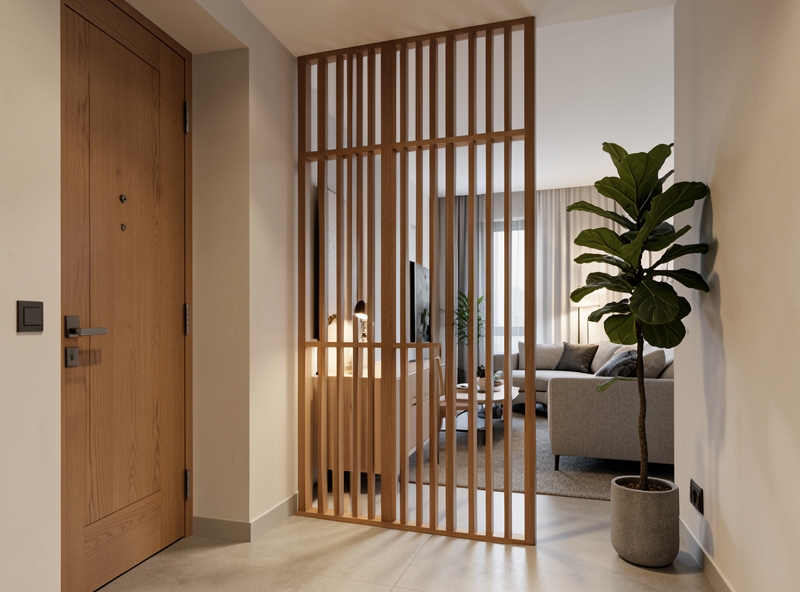
Additionally, don't forget to "Optimize" the flooring in this area. Using rugs with geometric patterns or changing flooring materials (e.g., from tile to wood) at the foyer acts as a sensory "traffic sign." It forces the airflow (and people) to slow down when entering the system. Completely resolving the Piercing Heart Sha error with screens or greenery is the most important "Patch" for your home to achieve an optimal state of "Dynamic Equilibrium."
- Note on Greenery: Priority should be given to plants with round, succulent leaves (such as Money Tree or Peace Lily) to act as "Capacitors" storing positive energy.
- Technical Distance: Screens or cabinets should be 1.2m to 1.5m away from the main door to ensure a "Buffer" space wide enough for movement.
- Materials: Avoid using large mirrors directly opposite the main door as they will immediately reflect all "Energy Data" back to the external environment.
3. Arranging Living Room Furniture to Enhance Vitality (Prosperity)
Think of your living room as a "motherboard" controlling the entire flow of energy throughout your home. To achieve optimal performance for the Feng Shui system, we aren't simply placing tables and chairs; we are designing a network architecture for Qi-flow. Fine-tuning the placement of key furniture components is an "overclocking" process for your living space, transforming dead corners into nodes that transmit positive energy.
The first critical point in this design diagram is the Sofa – acting as the Central Processing Unit (CPU). To ensure system stability, the Sofa must be placed in a "Solid Support" position. This means the back of the chair must rest against a solid wall. In Feng Shui techniques, this is the "Mountain Support" configuration, helping the sitter feel maximum security and safety, avoiding energy conflict errors from behind.
"Never install a Sofa under structural beams. In terms of architectural physics, beams create downward pressure on the airflow, causing energy turbulence and psychological oppression for the user."
Next, the coffee table should be arranged according to the "Open Space" principle so as not to obstruct the airflow bandwidth. The distance between the sofa and the coffee table must be wide enough to create a buffer zone, allowing Qi to circulate smoothly without bottlenecks. A coffee table lower than the sofa seat creates a harmonious "Green Dragon - White Tiger" structure, keeping energy gathered instead of dissipating too quickly.
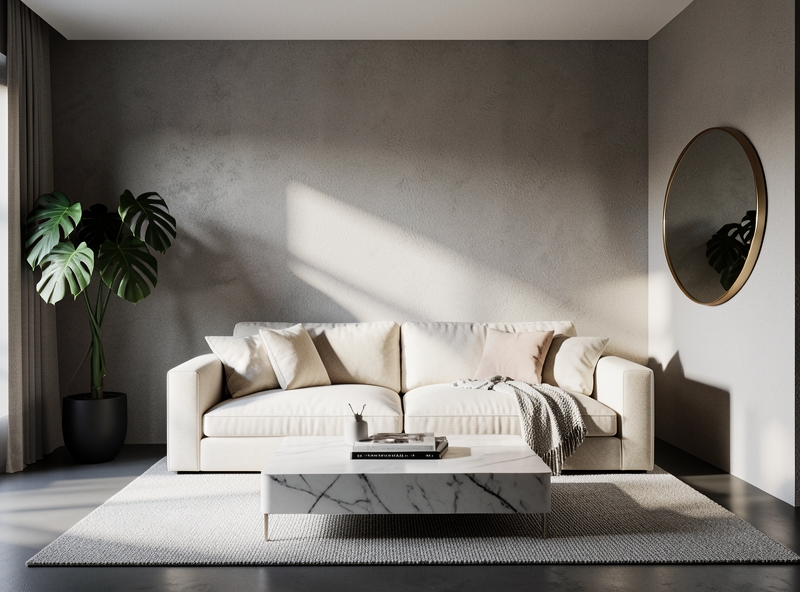
To resolve "dead zones" – those hidden corners where energy easily stagnates and falls into a "Lag" state, we need to use "amplifier modules":
- Mirrors (Mirroring logic): Use mirrors in dark corners to reflect light and expand virtual space. A mirror acts like a signal repeater, helping to guide the flow of Qi through stagnant areas.
- Greenery (Natural Cooling System): Plants with round, succulent leaves act as natural ion filters. Placing plants in hidden corners not only removes stagnant energy but also regenerates oxygen, improving the "Airflow" index for the entire living room system.
| Interior Component | Standard Configuration Parameters | System Benefits (Prosperity) |
|---|---|---|
| Sofa | Against a wall, not under beams | Increases stability, creates peace of mind and authority |
| Coffee Table | Lower than the sofa, 30-45cm distance | Maintains circulating airflow, avoids conflicts |
| Plants/Mirrors | Placed in hidden corners, blind spots | Diffuses energy, eliminates dead zones |
Applying these arrangement techniques helps the living room achieve a state of dynamic balance. When airflows are no longer obstructed by illogical obstacles, prosperity will automatically increase, bringing the highest living efficiency to the homeowner.
4. Balancing Energy for the Kitchen and Dining Area of an Apartment
If an apartment is considered a complex hardware system, then the kitchen area is the Power Supply Unit (PSU). However, modern apartment architecture often encounters an "open design" error that causes energy "data flow" conflicts. The most common situation is the kitchen placed right next to the main entrance or directly opposite the living room, creating a linear airflow energy vector that is extremely unfavorable for accumulating prosperity.
"In integrated interior design, handling energy 'noise' in the kitchen area is not just about feng shui, but also about scientifically optimizing movement flows and functional separation."
To fix the energy "packet loss" error when the kitchen faces the door, we need to set up a "filter." A CNC (Computer Numerical Control) partition system with slender patterns or a mini bar acts as a physical firewall. It helps redirect the airflow, forcing energy to move in a zigzag pattern, reducing speed, and permeating evenly into the space instead of escaping immediately.
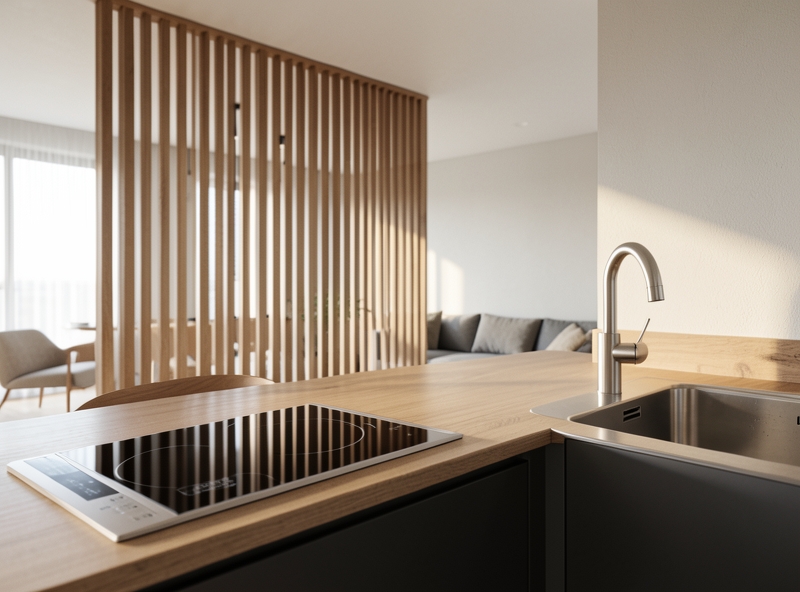
Next is the "Water - Fire Conflict" problem – a typical system logic error when placing the sink (Water) too close to the stove (Fire). According to operational technical specifications, the minimum safe distance (Buffer Zone) between these two areas must be 60cm. If your floor plan (layout) is too narrow, apply the following "patch updates":
- Insert intermediate materials: Use wooden cutting boards or wooden decorative details between the sink and the stove. In the five elements, Wood acts as an "interface" that helps transform Water to nourish Wood, and Wood to generate Fire, completely eliminating direct conflict.
- Level classification: If possible, design the sink 2-5cm higher or lower than the stove surface to create a separation in "energy layers."
- Optimize the Color Palette: Use Earth element tones such as cream, light yellow, or earthy brown for the kitchen tiles. The Earth color acts as a "regulator," helping to balance and keep the family fire stable.
| Conflict Position | Status | Technical Solution |
|---|---|---|
| Kitchen facing the main door | Energy leakage | Install a screen or a bar counter to redirect airflow. |
| Kitchen next to sink (<60cm) | Water - Fire conflict | Add Wood elements (Wood, green plants) to act as a bridge. |
| Kitchen facing the sofa | Causes thermal stress | Use floor rugs or pendant lights to define virtual boundaries. |
Balancing energy is not simply arranging furniture, but a process of "debugging" layout errors to create a living ecosystem that achieves the highest performance. Remember, a kitchen with stable energy is the foundation for maintaining "uptime" for the health and cohesion of every member in the apartment.
5. Optimizing Bedroom Feng Shui to Regenerate Health
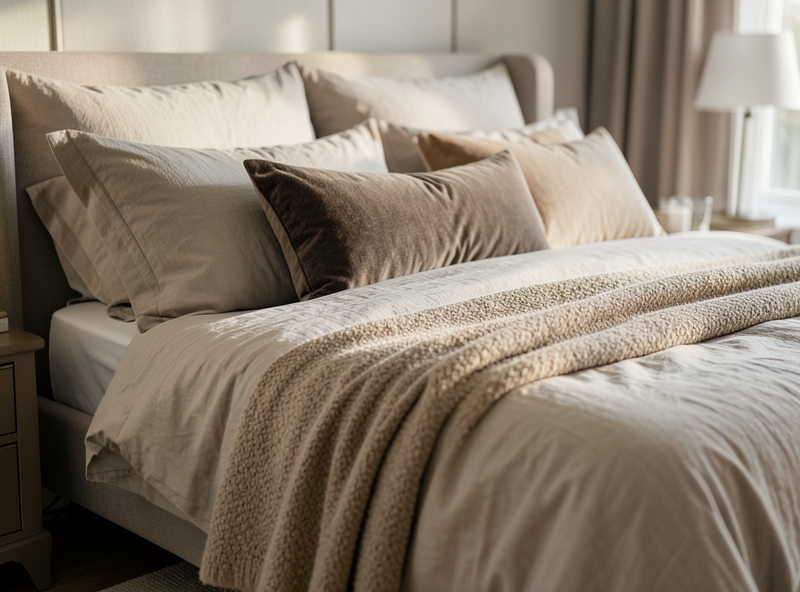
Welcome, "sleep architects"! Forget vague superstitious Feng Shui concepts; we are talking about setting up an optimal Space OS (Operating System) for your body. To recharge your "biological battery" after 16 hours of high-intensity activity, your bedroom needs its parameters fine-tuned—from the hardware position (furniture) to the data streams of light and airflow.
Let’s start with the room’s "CPU": The bed. In the Feng Shui algorithm, the bed must be placed in the Command Position. However, a common "Fatal Error" is placing the bed directly facing the entrance (also known as the coffin position) or opposite the bathroom door. Why? Technically, these are "I/O ports" (Input/Output) with high-variance airflow. When the bed lies on this straight axis, your body is subjected to sudden energy surges, causing brainwave interference during the REM (deep sleep) state. The bathroom is also a place of high humidity and stagnant air; placing the bed facing this door is like placing a faulty air filter right next to your respiratory system!
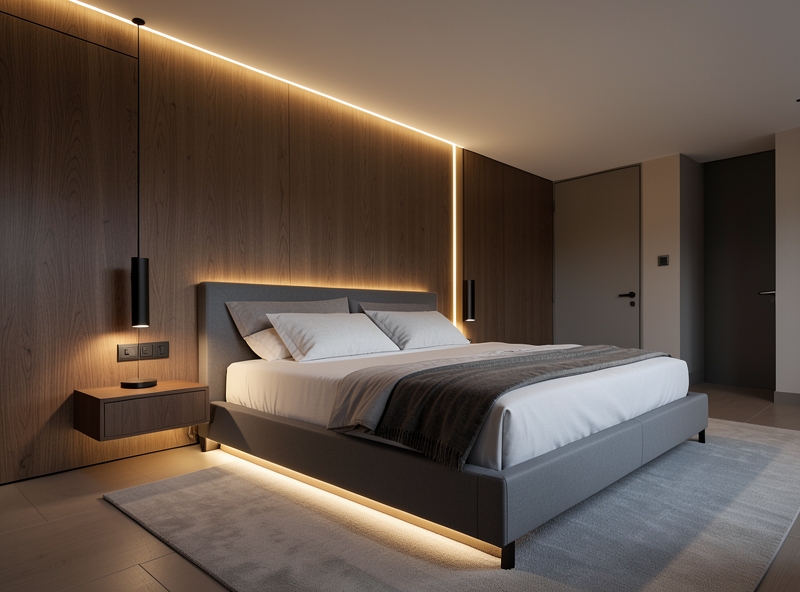
"Bedroom Feng Shui is essentially managing environmental disturbances to protect the recovery cycle of the central nervous system."
Next, let's address "visual pressure" from wardrobes and desks. These are "Big Data" blocks that occupy significant floor space. If you place a towering wardrobe right next to the head of the bed, you are creating a physical sleep paralysis effect. To optimize, apply the Clear Hierarchy rule:
- Wardrobe: Should be placed in hidden corners or along "static" walls, avoiding sharp corners of the cabinet pointing directly at the pillow (the "poison arrow" effect – Sha Chi).
- Desk: Absolutely do not let messy piles of documents stay within your line of sight once you lie down. Use closed storage solutions to "hide" work tasks, helping the brain trigger Shutdown mode instead of remaining in Standby.
Finally, fine-tune the Brightness & Color Temperature. To create a peaceful flow of energy (Qi), we must eliminate blue light—the number one enemy of Melatonin. Use a Layered Lighting system with color temperatures ranging from 2700K to 3000K. Indirect lighting sources like wall sconces or lamps with shades will help diffuse light evenly, avoiding sharp shadows, thereby soothing the visual system and putting the body into a state of absolute relaxation.
| Setup Parameters | Technical Impact | Health Benefits |
|---|---|---|
| Avoid facing the door | Airflow stability | Reduced startle response, deeper sleep |
| Hide the desk | Reduced visual noise | Disconnects work-related thoughts |
| 2700K Lighting | Triggers Circadian cycle | Increases natural Melatonin secretion |
This optimization is not just about arranging furniture; you are reprogramming your living environment to be perfectly compatible with your own biological rhythm. A "clean" space in terms of Feng Shui is the best infrastructure for sustainable health.
6. Summary
After we have performed the "stabilization" of the interior system, it can be confirmed that home decoration is not merely a matter of superficial aesthetics. It is a process of optimizing the System Architecture of the living space. The core principles of flexible arrangement represent "Hot-swapping" capability – where furniture modules can change position or function without causing conflicts to the overall flow of daily activities. An apartment with Dynamic Scaling capabilities will help the homeowner adapt to any usage scenario, from high-concentration "Deep Work" sessions to "Multi-user" events when hosting friends.
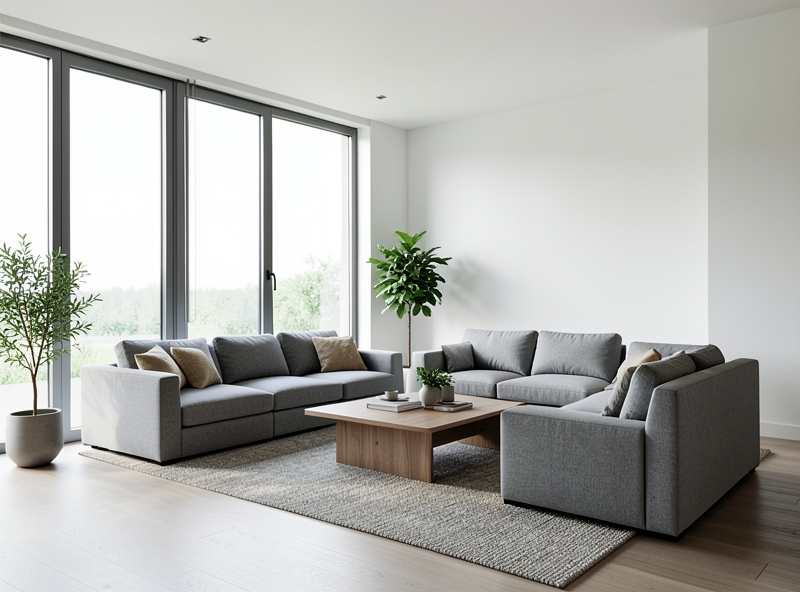
We need to redefine the concept of "Feng Shui" through a modern technical lens. Do not view it as mystical elements; instead, perceive Feng Shui as a form of Airflow Management and Signal-to-Noise Ratio. In which:
- Neatness (Clean Code): Removing redundant items is equivalent to cleaning up junk files in the registry. A clean space helps minimize visual "noise," allowing the brain to process information more efficiently.
- Cleanliness (Hard Drive Maintenance): Maintaining regular hygiene is a hardware maintenance step, ensuring that the "components" in the house always operate at their optimal state.
- Harmony (Load Balancing): Balancing actual usage needs with the natural circulation of airflow. If furniture is too dense (High Density), you will encounter a "Bottleneck," causing energy in the house to stagnate and fail to regenerate.
"Modern Feng Shui is the intersection of smart arrangement algorithms and behavioral psychology, where every square meter is configured to maximally serve the end-user experience."
To help you have the most comprehensive overview of the "technical specifications" of an ideal home, see the comparison table of spatial states below:
| Criteria (Spec) | Error Configuration (Legacy System) | Optimal Configuration (Modern Setup) |
|---|---|---|
| Layout | Fixed, rigid, difficult to change. | Modular, flexible, multi-tasking. |
| Flow | Many obstacles, causing "Latency" when moving. | Laminar flow, smooth. |
| Environment | Accumulation of dust and negative energy. | Well-ventilated, optimized natural light. |
Mastering these principles not only helps you own a beautiful "stopover," but also creates an ecosystem that provides maximum support for your health and spirit. Remember, your home is the Operating System for your life – program it as intelligently as possible!