
1. Introduction: The Difference Between Behavior Change and Identity Change
Why do 92% of self-improvement goals collapse after just a few weeks of initial excitement? You set an alarm for 5:00 AM to go jogging, resolve to read 30 pages a day, or force yourself into a strict diet. You push yourself with 200% willpower, only to end up exhausted and surrendering to the temptation of old habits. The mistake does not lie in your lack of willpower or laziness. The core mistake lies in this: You are trying to change behavior (what you do) instead of changing identity (who you believe you are).
The journey of sustainable self-improvement does not start with trying to force your body to perform a new action. It begins with reshaping your deep inner perception. When you only focus on behavior, you are trying to harvest sweet fruit while the roots of the tree are already decaying.

To clearly understand why traditional self-discipline building methods always fail, look at the fundamental difference between the two thinking models below:
| Comparison Criteria | Behavior Change (Outside-In) | Identity Change (Inside-Out) |
|---|---|---|
| Starting Point | Focus on outcomes (I want to lose 10kg, I want to write a book). | Focus on the type of person you want to become (I am an active person, I am a writer). |
| Operating Mechanism | Using willpower to force oneself to perform actions contrary to old habits. | Actions occur automatically as a natural reflection of internal beliefs. |
| Sustainability | Easily broken when willpower declines or when facing pressure and stress. | Lifelong, because actions have been assimilated with individual self-esteem. |
| Response to Temptation | "No thanks, I'm trying to quit smoking." (Still viewing oneself as a smoker). | "No thanks, I'm not a smoker." (Identity has changed). |
"The goal is not to read a book, the goal is to become a reader. The goal is not to run a marathon, the goal is to become a runner."
The concept of Identity-based habits points out that: Every action you take daily is a "vote" for the type of person you want to become. When you continuously repeat a small behavior, you are providing evidence to your brain that you actually are that type of person. No behavior change can last long if it contradicts the big picture you paint for yourself in your mind.
When you begin to shift from the mindset of "I have to do this" to "I am someone who always does this," all psychological barriers will be removed. Self-discipline at this point is no longer a painful and exhausting internal struggle, but a natural, consistent, and highly sustainable flow.
2. Why is Outcome-Based Discipline Often So Fragile?
You set your mind to wake up at 5:00 AM, create a detailed schedule, and prepare yourself with an iron will. But after only a week, the alarm clock becomes your "enemy" and you compromise to fall back into a deep sleep. This scenario repeats with every goal: from losing weight, learning a foreign language, to writing. Self-discipline by sheer willpower has a failure rate of up to 90% for one core reason: you are building a house from the roof down when you only focus on "outcomes" instead of "identity."
The traditional method of building discipline begins with the question: "What do I want to achieve?" (For example: Lose 5kg, read 2 books/month). This approach creates a psychological trap. When you exert effort to act solely for an outcome, every step feels like coercion and endurance. You view healthy action as a "punishment" and laziness as a "reward." Extreme focus on the outcome unintentionally turns the training process into a series of agonizing days.
"Outcome-based discipline only changes the surface of behavior. It forces you to fight with yourself every day, instead of changing the person who is performing that behavior."
The real collapse occurs when there is a cognitive dissonance between new actions and old beliefs. The brain's defense system always prioritizes cognitive consistency. If deep in your subconscious, you still label yourself as a "lazy person" or "someone with no artistic talent," then every effort to go to the gym or practice drawing is treated as a "foreign object" invading the ego's comfort zone. At this point, a self-sabotage mechanism is activated to pull you back to the old version of yourself you believe you belong to.

Forced effort without cognitive change is the direct cause of ego depletion. Willpower is a limited resource, functioning like an energy bar in a video game. When you must constantly use reason to suppress natural desires, this energy bar drains extremely quickly. By the end of the day, when stress accumulates and mental energy hits rock bottom, the defense mechanism collapses, and you immediately return to old bad habits to seek comfort.
| Comparison Criteria | Outcome-Based Discipline (Fragile) | Identity-Based Discipline (Sustainable) |
|---|---|---|
| Core Question | "What do I want to achieve?" (What) | "Who do I want to become?" (Who) |
| Driving Motivation | Pressure from external goals (Losing weight, making money) | Pride in internal identity (I am a healthy person) |
| Psychological State | Straining, forced, prone to ego depletion | Natural, consistent, acting out of habit |
| Sustainability | Short-term, disappears after achieving or giving up the goal | Lifelong, becomes part of a lifestyle |
To build an unbreakable system of discipline, you must stop forcing yourself to do things you hate just to exchange them for a vague outcome in the future. Instead, start by reshaping your own identity. Only when you believe you are a healthy person does choosing to eat a salad or walk for 30 minutes cease to be a life-or-death struggle of willpower, and simply becomes a natural action of who you are.
3. The Mindset Shift Mechanism: From 'What I Want to Achieve' to 'Who I Am'
Why are 92% of goals set at the beginning of the year abandoned by February? The answer doesn't lie in your lack of willpower or laziness. The core reason is that you are trying to change from the outside in rather than from the inside out. Blind effort without cognitive reshaping is just a temporary mask that old habits will strip away sooner or later.
To create a true breakthrough, we must understand the three-layer model of behavior change: Outcomes, Processes, and Identity. Imagine these as the three layers of an onion. The outermost layer is what you get, the middle layer is what you do, and the deepest core layer is what you believe about yourself.
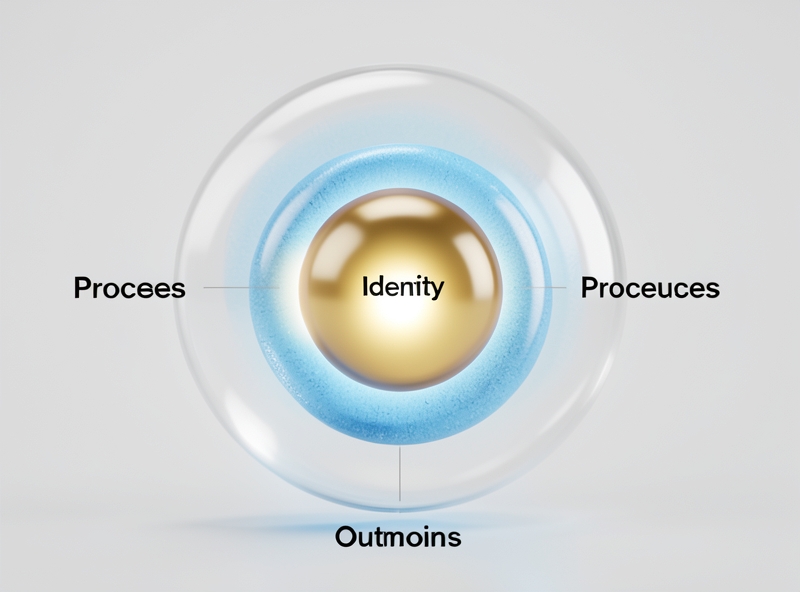
Most people begin their personal development journey by focusing on Outcomes (e.g., "I want to lose 10kg" or "I want to have $1 million"). They build Processes based on that outcome (e.g., "I will go on a diet" or "I will invest"). But they completely ignore the Identity core. They still hold onto their old beliefs like "I am someone with a sweet tooth" or "I am not good at financial management." As a result, when willpower runs dry, the old belief system drags them back to the starting line.
"True behavior change is not about trying to achieve something, but about who you become."
When you shift your mindset to the Identity core, every decision and action automatically follows a new operating system. Look at the stark difference between the two approaches through the comparison table below:
| Situation | Outcome-based approach (What I want to achieve) | Identity-based approach (Who I am) |
|---|---|---|
| Declining a cigarette | "No, thank you, I'm trying to quit." (Willpower is doing the heavy lifting, deep down they still see themselves as a smoker trying to restrain themselves). | "No, thank you, I'm not a smoker." (Smoking is no longer part of how they define themselves). |
| Exercise and fitness | "I have to go to the gym to get a good body." (An action driven by obligation, easy to give up when tired). | "I am an active and health-conscious person." (Going to workout is to align with their own identity). |
| Career development | "I want to write a best-selling book." (The pressure to produce results leads to procrastination). | "I am a writer." (Focusing on the act of writing every day, the results will naturally follow). |
Every action you take each day is a vote for the type of person you wish to become. If you write consistently every day, you are voting for the identity of a writer. If you exercise regularly, you are voting for the identity of an athletic person. You don't need to be perfect; you just need to win the majority of the votes.
To start shifting your mindset today, stop asking yourself: "What goals do I want to achieve?". Instead, seriously answer the question: "Who is the type of person who can achieve the goals I desire?". Once you define your new identity, your behavior will change automatically without the forced application of willpower.
4. The 2-Step Process to Establish Identity-Based Habits for Creating Iron Discipline
Why do 95% of personal development plans fail within the very first month? The answer lies not in willpower, but in the approach. Most people try to change outcomes (like losing 5kg, reading 20 books) or change processes (waking up early at 5:00 AM) while forgetting the deepest level: changing identity.
If you only try to force yourself to act like a disciplined person while deep down inside you still view yourself as a lazy person, your brain will always find a way to pull you back to your old comfort zone. To build an unbreakable iron discipline, you need to reverse this process using the 2-step identity-based habit formulation formula below.

Step 1: Clearly define the type of person you want to become
Instead of asking "What outcomes do I want to achieve?", ask the question: "Who do I want to become?". This is the step to establish your core value system and character, shaping your entire behavior thereafter.
- Shift goals into identity: Instead of saying "I want to write a book" (Outcome), define it as "I am a professional writer" (Identity). Instead of "I want to run a marathon," declare "I am an athlete."
- Build a core value system: Clearly identify the qualities this role model possesses. How would a capable leader behave when facing a crisis? How would a person with a healthy lifestyle choose their menu at a party?
Once you shape your new identity, every decision of the day will no longer be an exhausting psychological struggle, but a natural reflection of who you are.
Step 2: Prove that identity with small wins
Identity is not born out of thin air from empty affirmations in front of the mirror. Your brain needs practical evidence. Every action you take daily, no vote matter how small, acts as a "vote" reinforcing that new identity.
"Every small action you take is a vote for the person you want to become."
If you want to build the identity of an "orderly person," every time you make your bed right after waking up is a vote. If you want to become a "consistent person," sitting down at your desk on time regardless of your feelings is another vote.
| Traditional Goal (Easy to give up) | Target Identity (Sustainable) | Small Daily Vote (Small Wins) |
|---|---|---|
| Try to read 50 pages of a book every day. | I am an eager learner. | Read exactly 2 pages of a book before going to sleep. |
| High-intensity gym workout for 2 hours/day. | I am a proactive health caregiver. | Put on your shoes and walk for 10 minutes every morning. |
| Write a 3000-word blog post. | I am a true content creator. | Write 1 idea or 3 draft lines every day. |
When you accumulate a sufficient number of votes, the balance of belief in your mind will automatically tilt towards the new identity. You no longer have to strain yourself to maintain discipline, because discipline at this point is who you truly are.
5. How to nurture and protect your new identity from daily temptations
You decide to become a healthy person, but then you succumb to a box of pastries at 10 PM. Guilt immediately sets in, accompanied by that familiar voice: "Since I've already messed up, I might as well finish it today". This is a classic manifestation of the "What-the-hell effect" - the most ruthless psychological trap that destroys all your efforts to shape a new identity. Human willpower is a finite resource. To protect your new self from the powerful pull of old habits, you cannot rely solely on determination; you need an active defense system.

Below are three practical methods to help you stay on track, even when daily temptations try everything to drag you back to the starting line.
Environmental Design: Let your environment run on autopilot instead of willpower
Willpower will always fail in an environment full of temptation. If you want to become a focused worker, but your phone is always next to your hand and constantly lighting up, you are setting yourself up to lose. You must increase friction for bad habits and decrease friction for good behaviors:
- Isolate distractions: If you want to scroll less on social media at night, leave your phone charger in the living room. Want to read more books? Place a book right on your pillow after making the bed in the morning.
- Synchronize your space: Turn your living space into an "external memory" that reminds you of your new identity. A yoga mat always rolled out, a large pitcher of filtered water placed right on your desk are triggers that activate automatic behavior without consuming mental energy.
Self-talk Techniques: Shift from "I can't" to "I don't"
The words you use every day directly shape how your brain responds to temptation. When offered a sugary milk tea, what is your reflex? The difference between the two ways of declining below will determine your ability to maintain your new identity:
| Type of Dialogue | Verbal Syntax | Psychological Mechanism Activated |
|---|---|---|
| Self-restraint (Limitation) | "I'm not allowed to drink..." or "I'm on a diet." | Creates a feeling of being deprived of freedom. The brain will constantly crave it and try to compensate later. |
| Identity Positioning (Affirmation) | "I am not a sweet-toothed person." or "I don't drink milk tea." | Establishes a natural boundary based on identity. There is no internal struggle because that is who you are. |
Instead of playing the victim struggling to endure disciplinary rules, talk to yourself in the language of someone who already possesses that identity. You are not trying to quit smoking; you simply are not a smoker.
Compassionate Mindset and the "Never Miss Twice" Rule
The biggest mistake of people who fail in personal development is the "All-or-Nothing" mindset. They believe that missing just one day of exercise or accidentally eating a cookie ruins the entire plan. In reality, consistency is more important than absolute perfection.
"A single slip is an accident. The second consecutive slip is the start of a new bad habit."
When you accidentally break discipline, apply a compassionate mindset to stop the "What-the-hell effect" in its tracks:
- Accept reality without judgment: Acknowledge the slip as experimental data, not a measure of your worth as a person. Did you miss a workout session? No problem, that is just a normal part of life.
- Activate the recovery filter immediately: Tell yourself that the next meal or the next day must get back on track. Absolutely do not let the detour extend to a second consecutive time.
Every action you take is a vote for the version of yourself you want to become. You don't need 100% of the votes to win this internal election; you just need a majority. Protecting a new identity is not a flawless sprint, but a journey of accumulating every single small vote in the most persistent and resilient way.
6. Summary
Many of us still rush into the journey of personal development like a self-punishing ascetic: forcing ourselves into harsh schedules, cutting out all hobbies, and constantly tormenting ourselves when we fail to meet our goals. The consequence is exhaustion, frustration, and an endless loop of procrastination. That is when you realize that the discipline method based on physical coercion has completely failed.
The truth is, true discipline is not coercion or punishment. Discipline is ultimate freedom – the privilege to live true to the identity, values, and highest standards that you proudly set for yourself. When you change your identity from deep within, disciplined action is no longer a battle against instinct, but a proud willingness.
| Forced Discipline (The Path of Failure) | Identity-Based Discipline (True Freedom) |
|---|---|
| Trying to force habits due to external pressure or fear of failure. | Acting consistently every day because it is a direct reflection of the person you want to become. |
| Always feeling deprived of freedom, constantly seeking opportunities to "indulge" and compensate. | Feeling in control of destiny, freely choosing the pain of discipline over suffering the pain of regret. |
When you stop viewing discipline as the enemy of freedom, you will see it as the only launchpad to help you reach the most brilliant version of yourself. This shift does not require grand plans; it begins with quiet but decisive micro-decisions every day.

"Discipline is not about forcing yourself to do things you hate to achieve results. Discipline is about giving up immediate desires to remain absolutely loyal to the greatest person you can become."
Start your personal revolution today, not by forcing yourself to achieve overwhelming goals, but by a change in your deepest mindset. Before every choice, ask yourself: "What decision would the version of me that I am most proud of make in this moment?". When your mindset is realigned, your actions will naturally align. Be persistent in accumulating small wins, because it is those nameless choices in the dark that will lead you into the light of true maturity.