1. What is Emulsification? An Overview of the Magical Phenomenon in the Sauce World
Have you ever helplessly watched a painstakingly made bowl of Hollandaise sauce **break into a runny, greasy, failed mixture**? Or wondered why with just egg yolks and cooking oil, master chefs can create a **silky-smooth, velvet-like** Mayonnaise? The answer lies not in luck, but in a classic culinary-chemical reaction: **Emulsification**.
In nature, **oil and water are sworn enemies**. Polar water molecules tightly attract each other like magnets, while non-polar oil molecules are completely pushed away. With simple mechanical stirring, oil quickly floats to the top, separating into two distinct layers. Emulsification is the **chemical bridge** that breaks this natural law, forcing two naturally conflicting liquids to blend into one.
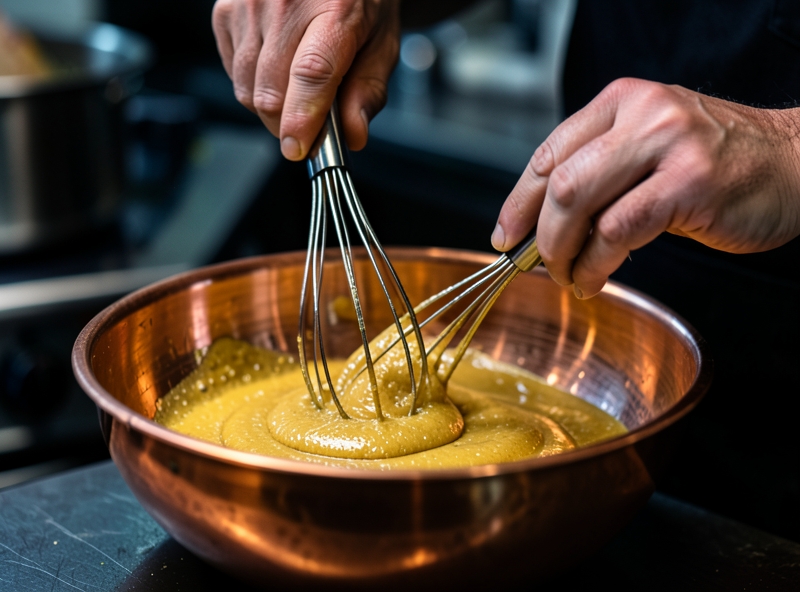
For this magic to happen, your kitchen must feature an **Emulsifier**—wonderful molecular "diplomats." The structure of an emulsifier is highly unique, featuring two ends:
- Hydrophilic end (Water-loving): Clings tightly to water molecules.
- Lipophilic end (Fat-loving): Grabs onto microscopic oil droplets.
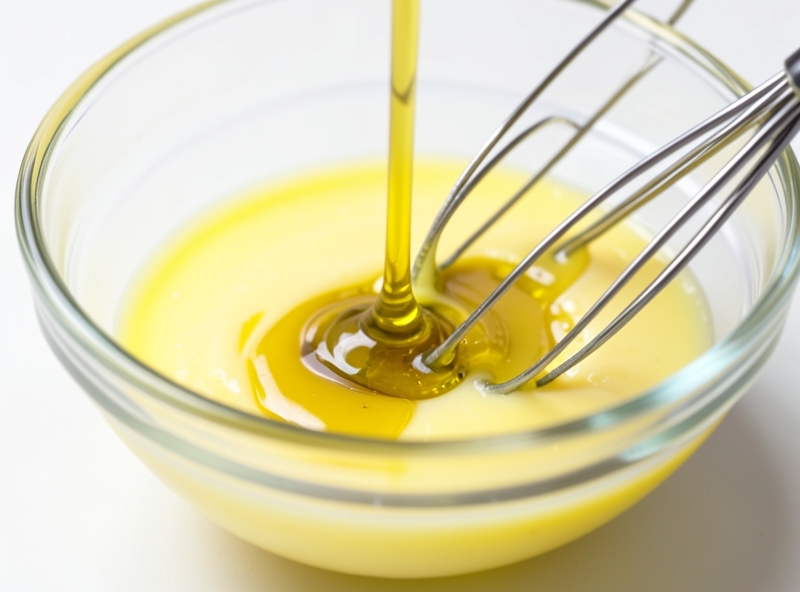
When you apply mechanical force (using a whisk or blender), the oil is broken down into millions of tiny droplets. The emulsifier immediately encapsulates each droplet, preventing them from coalescing again. The result is a stable suspension system that delivers the signature **thick, smooth, velvety, and rich texture** of sauces.
"Emulsification is not just a cooking technique—it is a physicochemical revolution that transforms separate, loose ingredients into a velvety-smooth symphony of texture on the tongue."
In the art of sauce making, emulsification is divided into two basic types that anyone wanting to master the kitchen needs to understand clearly:
| Emulsion Type | Mechanism of Action | Classic Examples | Mouthfeel |
|---|---|---|---|
| Oil-in-Water | Tiny oil droplets are evenly dispersed in a water base. | Mayonnaise, Hollandaise sauce, Béarnaise sauce, Milk. | Rich, smooth, creamy, and velvety without being overly greasy. |
| Water-in-Oil | Small water droplets are dispersed inside an oil/fat medium. | Butter/Margarine, classic Vinaigrette. | Melts quickly, releasing rich flavor instantly. |
Understanding the true nature of emulsification is the **master key** that allows you not only to execute classic sauce recipes with precision, but also to confidently **rescue broken sauces** in just a few seconds. By controlling temperature, fat ratios, and whisking force, you can completely master the art of creating restaurant-quality dishes right at home.
2. The Chemical Mechanism Behind the Blending of Oil and Water
The worst nightmare for any professional chef or home cook is seeing Mayonnaise or Hollandaise suddenly break into a messy, curdled liquid mixture right before serving. This costly mishap isn't due to poor skills or "bad luck," but because you just severely violated a basic physical-chemical law: Oil and water naturally cannot dissolve in each other.
In essence, polar water molecules tightly attract each other through strong hydrogen bonds, while non-polar fat molecules repel water. To force these two "sworn enemies" to join hands and create a smooth, velvety sauce texture, you must build an emulsion consisting of two opposing components:
- Dispersed phase: The liquid broken down by mechanical force into millions of microscopic droplets (only 0.1 to 10 micrometers in size). In oil-based sauces, this is the fat.
- Continuous phase: The surrounding liquid medium that acts as a "network" supporting the dispersed droplets. In cooking, this phase is usually water, vinegar, lemon juice, or egg whites.
Imagine trying to stuff millions of rubber balls (dispersed phase) into a room full of water (continuous phase). Without a specialized binder, the balls will immediately collide, merge, and float to the surface of the water. In food chemistry, this phenomenon is called coalescence—the root cause of broken sauces.
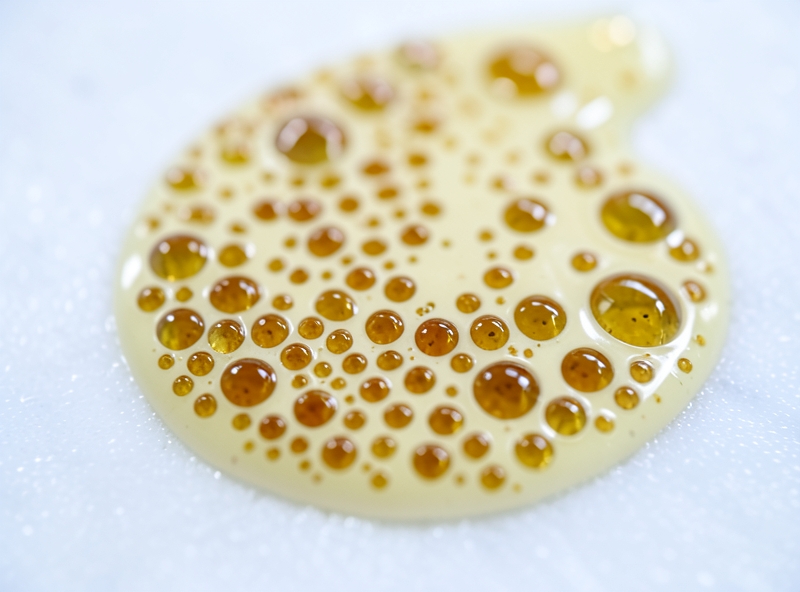
The secret to reversing this natural law, turning a loose mixture into a rich, thick, smooth sauce, lies in a key molecule: Emulsifier. In the kitchen, the most supreme and common emulsifier is Lecithin (abundantly found in egg yolks) or Mucilage (the mucilaginous substance in Dijon mustard).
An emulsifier molecule possesses a miraculous amphiphilic structure with two completely opposite reactive ends:
- Hydrophilic head: Carries a polar charge, tending to cling tightly to water molecules in the continuous phase.
- Lipophilic tail: Composed of non-polar fatty acid chains, plunging directly into the center of each dispersed oil droplet.
When you whisk or blend vigorously, mechanical force shreds the oil into countless tiny droplets. Instantly, millions of Lecithin molecules surround each oil droplet: the lipophilic tails plug inside, while the hydrophilic heads face outward. This structure forms a solid electrostatic and steric barrier enveloping each fat droplet.
"An emulsifier acts as a molecular mediator, reducing interfacial tension between oil and water from an extremely high ~50 mN/m to below 2 mN/m, eliminating self-attraction forces and preventing oil droplets from colliding and merging together."
The precise balance between the dispersed phase, continuous phase, and emulsifier directly determines the state and stability of classic sauces:
| Classic Sauce Type | Dispersed Phase | Continuous Phase | Key Emulsifier | Technical Limit Ratio |
|---|---|---|---|---|
| Mayonnaise | Cooking oil (70% - 80%) | Water, vinegar, lemon juice | Lecithin (Egg yolk) | 1 yolk : Max 175ml oil |
| Hollandaise | Melted butter (Fat) | Reduced liquid/stock, lemon juice | Lecithin + Slightly denatured egg protein | 1 yolk : Max 85g butter |
| Vinaigrette (Temporary emulsion) | Extra Virgin olive oil | Wine vinegar / Lemon juice | Mucilage (Dijon mustard / Honey) | 3 parts oil : 1 part vinegar |
Understanding this chemical nature grants you the power to instantly "rescue" any broken sauce. If Mayonnaise breaks, the reason isn't spoilage, but because the continuous phase has been depleted (adding oil too quickly leaves insufficient space to keep oil droplets separated). The scientifically sound fix: Whisk 1 teaspoon of warm water (or a fresh egg yolk) in a clean bowl to re-establish the continuous phase, then slowly whisk in the broken sauce. The amphiphilic membrane will immediately restructure, restoring a smooth, perfect sauce texture just like before.
3. Analysis of Emulsification Mechanisms in Classic Sauces: Mayonnaise, Hollandaise, and Vinaigrette
Sauce breaking, curdling, or turning into a messy liquid mixture is the ultimate nightmare in both cold and hot kitchens. The essence of emulsification is not magic, but **surface physics and food chemistry**. When two naturally immiscible liquids (oil and water) are forced to mix, you need mechanical energy to break down the dispersed phase, combined with a **surfactant** strong enough to prevent oil droplets from merging (coalescence).
Differences in temperature, emulsifier characteristics, and matrix stability among Mayonnaise, Hollandaise, and Vinaigrette create three distinct emulsification states.
1. Mayonnaise: Permanent Cold Emulsification and the Power of Lecithin
Mayonnaise represents a highly stable cold **Oil-in-Water (O/W)** emulsion system. The continuous phase is a mixture of vinegar, lemon juice, and water naturally present in egg yolks. The dispersed phase is cooking oil.
- Core emulsifier: Lecithin (Phosphatidylcholine) in egg yolks. This molecule has an amphiphilic structure: a hydrophilic head sticking into the water phase, and a lipophilic tail tightly binding to the oil droplet, forming a protective barrier that prevents oil droplets from coalescing.
- Critical technique: The initial rate of adding oil. At the very beginning, the water phase is extremely small. If oil is poured too fast, the ratio of the oil phase exceeds Lecithin's wrapping capacity, causing the system to collapse instantly. Oil must be added drop by drop under high **shear force** from a whisk or blender.
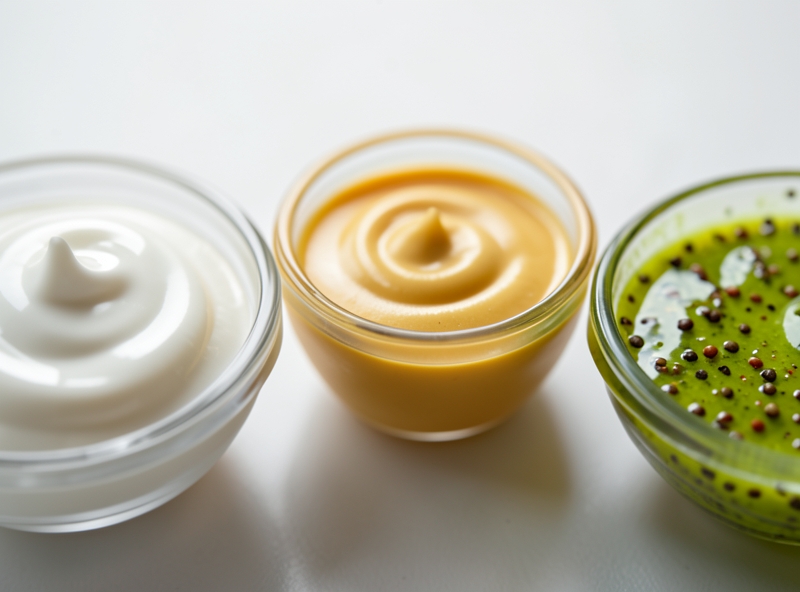
2. Hollandaise: Warm Emulsification and the Brutal Challenge of Temperature Control
Hollandaise is considered a technical pinnacle because it combines **emulsification with protein coagulation**. Unlike Mayonnaise which uses room-temperature oil, Hollandaise uses warm **clarified butter** in a liquid state and egg yolks.
- The golden temperature range (62°C – 68°C): At this temperature threshold, proteins in egg yolks denature and lightly bind together, creating a desirable thickness for the sauce.
- Technical breaking point: If the temperature falls below **55°C**, the butter begins to solidify, breaking the emulsion. If it exceeds **70°C**, egg proteins fully coagulate (scrambled eggs), releasing all water and expelling the oil (Syneresis phenomenon). Liquid butter must have milk solids strained off to ensure the purity of the oil phase.
"Failure in emulsification does not stem from poor ingredients, but from disregarding the addition rate of the dispersed phase and the protein denaturation at specific temperature thresholds."
3. Vinaigrette: Temporary to Semi-Permanent Emulsification
The foundation of a traditional Vinaigrette consists only of vinegar and oil at a standard ratio of 1:3. This is a **temporary emulsion** system. If relying solely on mechanical whisking, oil droplets will separate from the vinegar after just a few minutes due to high surface tension.
- Natural co-emulsifiers: To convert a Vinaigrette into a **semi-permanent** system, adding **Dijon mustard** or **honey** is essential. Mustard contains mucilage and complex polysaccharides that act as surfactants encapsulating the oil droplets.
- Viscosity enhancement mechanism: Honey and mustard increase the viscosity of the continuous phase (vinegar), significantly slowing down the Brownian motion of oil droplets and extending sauce stability from minutes to hours.
| Comparison Criteria | Mayonnaise | Hollandaise | Vinaigrette |
|---|---|---|---|
| Emulsion Type | Permanent Cold Emulsion (O/W) | Heat-Unstable Warm Emulsion (O/W) | Temporary or Semi-Permanent (O/W) |
| Continuous Phase | Lemon juice, vinegar, water in egg | Vinegar/wine reduction water, water in egg | Vinegar, acidic fruit juice |
| Dispersed Phase | Vegetable oil (neutral) | Warm clarified butter | Olive oil / Vegetable oil |
| Primary Emulsifier | Lecithin (Egg yolk) | Lecithin + Lightly denatured egg protein | Dijon mustard, Honey, Minced garlic |
| Operating Temperature | 15°C – 25°C (Room temperature) | 60°C – 65°C (Bain-marie / Water bath) | 15°C – 25°C (Room temperature) |
| Fatal Error Causing Breaking | Pouring oil too quickly at the start | Overheating (>70°C) or Butter too cold | Lack of co-emulsifiers, insufficient whisking force |
Mastering the molecular nature of these three emulsification systems helps you not only gain full control over the quality of the final product, but also easily **rescue broken sauces**. For broken Mayonnaise or Hollandaise, simply recreate a new continuous phase (one egg yolk or 15 ml of warm water) and slowly whisk the broken sauce in as if it were a new oil phase; the binding matrix will immediately recover its original state.
4. Causes of broken sauce and secrets to fix it successfully
The moment a bowl of smooth Mayonnaise or Hollandaise suddenly turns into a slimy liquid mixture with a floating oil slick is a costly "nightmare" for anyone in the kitchen. In just a few brief seconds, all expensive ingredients and preparation effort risk going straight into the trash. This mishap isn't a matter of bad luck; it is a purely physicochemical reaction when the **emulsification process breaks down**.
In essence, an emulsified sauce is forcing two sworn enemies — fat (oil/butter) and water (lemon juice/vinegar/egg yolk) — to blend together. Egg yolks contain Lecithin, which acts as an emulsifier that coats tiny oil molecules. When this structure breaks down, the oil droplets pool together and separate from the water phase. Below are 3 "deadly causes" that make a sauce break instantly:
- Pouring oil too quickly (Volume overload): This is the most common mistake. In the initial stage, there is not enough emulsifier to coat such a large volume of oil all at once. Pouring too fast causes oil droplets to collide, merge into larger slicks, and expel the water.
- Exceeding temperature thresholds: Emulsification is extremely sensitive to heat. Temperatures exceeding **65°C** will coagulate the egg proteins, completely stripping away their ability to hold oil. Conversely, excessively cold temperatures cause saturated fats to solidify, breaking molecular bonds.
- Exceeding the maximum capacity ratio: A standard egg yolk can only emulsify a maximum of **180ml - 200ml of oil**. Greedily exceeding this physical limit without adding more water phase or emulsifier will automatically break the system.
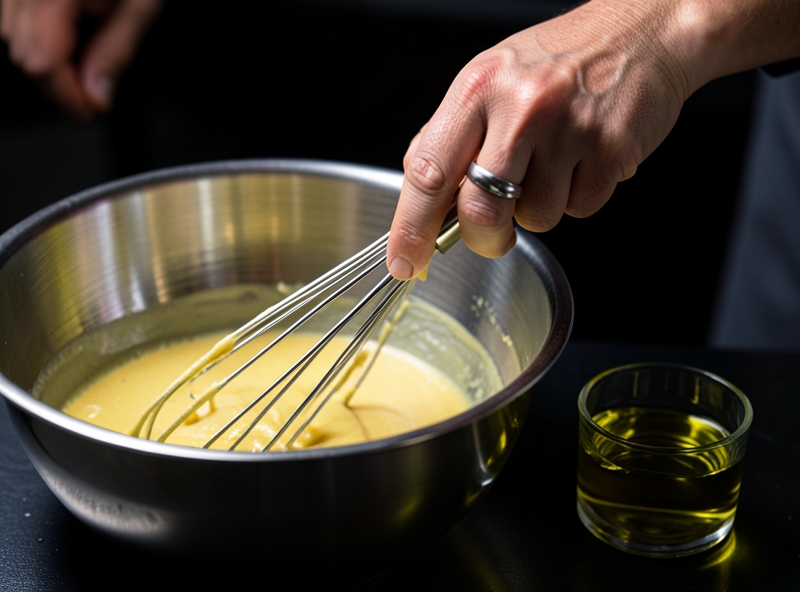
To identify early and thoroughly handle each case, refer immediately to the professional kitchen technical reference table below:
| Identifiable Symptom | Root Cause | Immediate Fix |
|---|---|---|
| Sauce is runny with a thin film of oil on the surface | Oil poured a bit too fast or lack of initial moisture. | Add 1 teaspoon of **warm water**, whisk extremely fast. |
| Sauce is curdled/grainy, oil is clumping | Overheating cooked the egg or oil ratio exceeded the limit. | Use the **emulsion re-creation** technique with a fresh egg yolk. |
| Sauce turns overly thick then suddenly separates | System lacks water phase (too dry). | Add a few drops of **lemon juice** or **warm water** to thin it out. |
"In a professional kitchen, there are no ruined sauces, only sauces that haven't been restored with the right technique. Emulsification is the art of balancing mechanical force and temperature."
If your sauce mixture has completely broken, don't rush to throw it away. Immediately apply these 2 **rapid rescue protocols** successfully used 100% of the time by top chefs:
Method 1: "Re-activation" Technique using Warm Water (Applied when the sauce just begins to break)
Take another clean bowl and add **1 teaspoon (5ml) of warm water** (around 40°C - 45°C). Spoon small amounts (about 10ml) of the broken sauce into the warm water bowl, whisking vigorously in one direction until the mixture begins to turn opaque and smooth again. Once a new emulsion "core" is formed, gradually pour in the remaining broken sauce while whisking steadily.
Method 2: "Rebirth" Technique using Fresh Egg Yolk (Applied to severely curdled/completely broken sauce)
- Step 1: Prepare a completely dry, clean bowl, add **1 fresh egg yolk** along with **1/2 teaspoon of lemon juice** or warm water. Whisk until the mixture is light and slightly frothy.
- Step 2: Treat the entire old broken sauce mixture like a regular bowl of cooking oil.
- Step 3: Add the broken sauce **drop by drop** into the fresh egg yolk bowl, whisking continuously without stopping. As the mixture begins to emulsify and thicken, you can gradually increase the pouring speed. The sauce structure will instantly return to a perfectly smooth state as if no mishap ever occurred.
5. Conclusion
A juicy steak or a premium seafood dish can be completely ruined by just a spoonful of broken, greasy sauce. The only difference between a bland, failed sauce and a silky smooth, Michelin-standard sauce isn't luck—it lies in the science of emulsification.
Emulsification is the physical magic that transforms two elements that "don't belong together"—water and fat—into a single harmonious whole. When you understand how surfactants work, such as Lecithin in egg yolks or Mucilage in Dijon mustard, you no longer view a recipe as a set of blind instructions. You officially master fluid dynamics in the kitchen: precisely controlling temperature, adjusting the rate of adding oil, and optimizing the shearing force of the whisk.
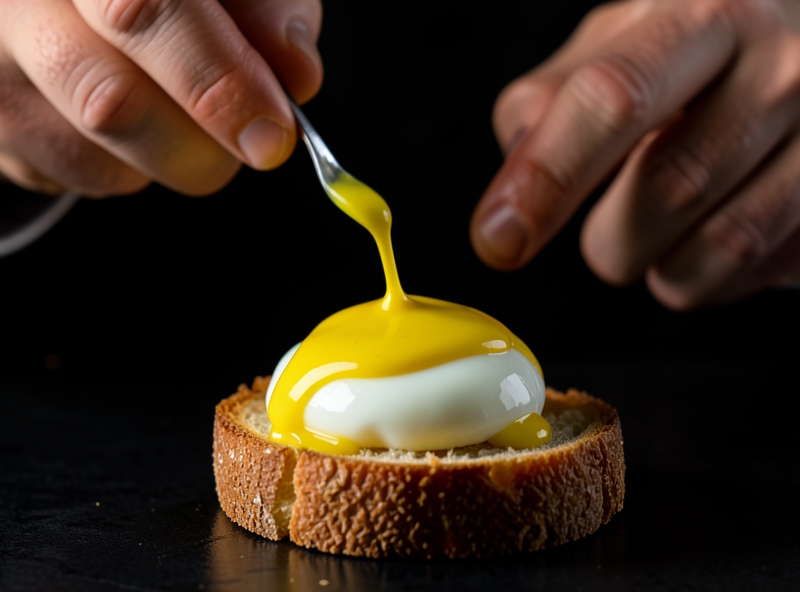
Understanding and mastering the emulsification technique brings distinct advantages to any cook:
- Absolute texture control: Sauces always achieve perfect smoothness, with no more clumping or breaking when reheated.
- Explosion of flavor layers: Microscopic fat droplets encapsulate flavor molecules, helping unleash taste slowly and linger longer on the tongue.
- Unlimited creative freedom: From handmade Mayonnaise and rich Hollandaise to delicate Vinaigrette—you can create hundreds of signature sauces from the most basic ingredients.
"Sauce is the soul of a dish, and the science of emulsification is the beating heart of the sauce maker."
Stop relying on pre-packaged sauce bottles full of preservatives and artificial additives. Incorporating the science of emulsification into your cooking process not only elevates dish quality to a new level, but also asserts your own superior culinary mindset. Pick up your whisk, start by understanding the nature of your ingredients, and transform every home meal into a luxurious dining experience.