1. Overview of Egg Proteins: The Magical 'Key' to Culinary Arts
Why is it that with the exact same egg, one person turns it into a rubbery, watery, overcooked scrambled mess, while a Michelin chef creates a velvety, dangerously creamy texture bursting with flavor? The fine line between a culinary disaster and a masterpiece lies not in luck, but in the micro-level control of protein structures.
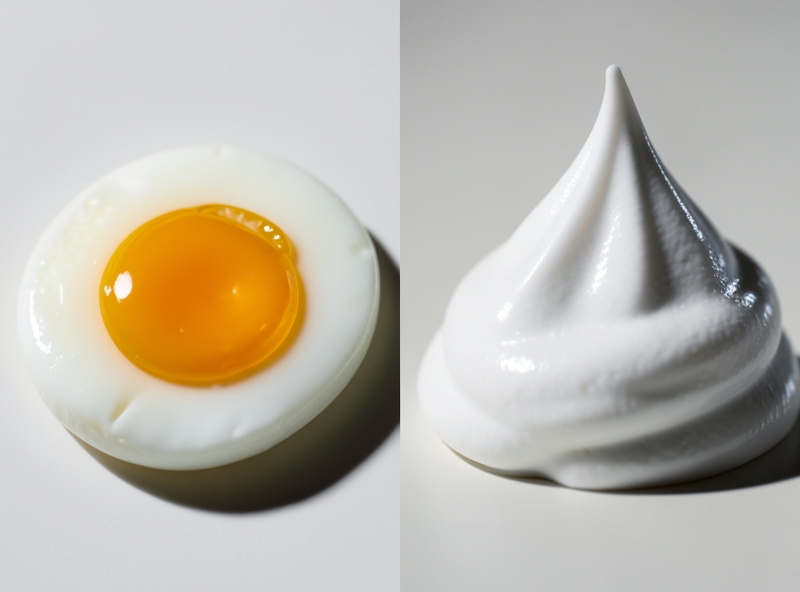
Eggs appear in everyday kitchens as a quick fried egg, yet they also serve as the core element behind the elegant rise of a Soufflé or the magical richness of a Hollandaise sauce in haute cuisine. To master this classic ingredient, you must start with its molecular map: egg whites and egg yolks are two completely separate protein worlds, each with its own unique mechanism of action.
| Component | Dominant Proteins | Denaturation Temperature | Technical Function in Cooking |
|---|---|---|---|
| Egg White (Albumen) | Ovalbumin (~54%) Ovotransferrin (~12%) |
62°C – 80°C | Creates a sturdy structural framework, traps air bubbles (Meringue), retains moisture, and sets the shape of dishes when heated. |
| Egg Yolk (Yolk) | Lipoproteins (HDL, LDL) Livetin, Phosvitin |
65°C – 70°C | Provides rich, creamy texture and acts as a natural emulsifier (binding water and fat) for sauces. |
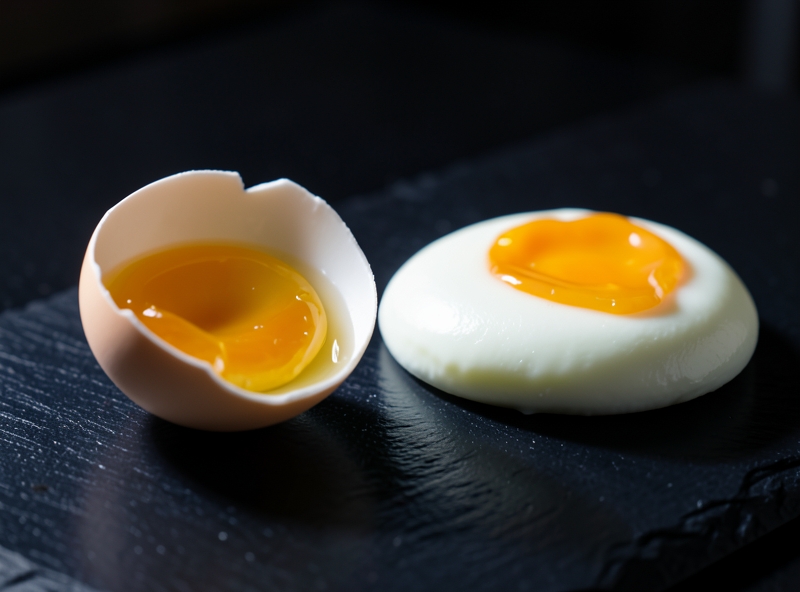
The essence of cooking eggs lies in controlling the denaturation and coagulation of proteins. In their raw state, protein chains are tightly coiled like balls of yarn drifting in water. When you apply heat or mechanical force:
- Mechanical Force (Whipping): Shear force unfolds and stretches the protein chains. The hydrophilic (water-loving) ends bind to water, while the hydrophobic (water-repelling) ends face outward into the air, extending to trap air bubbles and forming a stable foam structure for baked goods.
- Thermal Effect (Cooking): As the temperature rises, weak bonds break. The protein chains uncoil and cross-link with each other to form a three-dimensional network that traps water molecules inside.
"Overheating causes the protein network to squeeze together too tightly, much like a wrung-out sponge, expelling all the moisture and turning the food rubbery. Mastering temperature means mastering the juiciness of the dish."
Understanding the distinct characteristics of Ovalbumin (heat-resistant, providing final firmness) and Ovotransferrin (highly heat-sensitive, coagulating early at 62°C) allows you to effortlessly control texture. Want a poached egg with whites just firm enough to encase a runny yolk? Keep the water temperature precisely at 63°C - 65°C. Want a Chiffon cake to achieve maximum loft? Whip the egg whites to stiff peaks at just the right moment to fully harness the elasticity of Ovalbumin.
The key to culinary excellence lies not in memorizing recipes, but in the ability to control molecular protein transformations right in your pan.
2. Thermal Denaturation: The Secret to Creating Textures from Rich Jammy Yolks to Perfect Coagulation
How many times have you been disappointed peeling a boiled egg with rubbery whites, a dry, crumbly sulfur-smelling yolk, or a bowl of Hollandaise sauce broken into an oily mess? Most cooks prematurely blame cooking time, but the real game-changer is temperature precision down to the exact degree Celsius. Understanding the mechanism of thermal denaturation is the dividing line between an instinctive home cook and a chef who commands culinary science.
At its core, thermal denaturation is a physical restructuring process at the molecular level. In their natural state, egg protein chains are tightly coiled and suspended in water held by weak hydrogen bonds. When heat is applied, the increased kinetic energy breaks these hydrogen bonds, causing the protein chains to uncoil. Immediately, the uncoiled ends seek each other out, intertwining into a new network of hydrogen and disulfide bonds that traps water molecules inside. This process transforms the initial liquid into a delicate gel or a solid structure.
"Cooking is not an art of guesswork. It is the science of controlling protein denaturation to trap moisture at the right moment and stopping before that network contracts and squeezes out all moisture."
The key point lies here: Egg whites and egg yolks do not coagulate at the same temperature. A variance of just 5°C is enough to turn a sublime dish into a culinary disaster.
| Component | Coagulation Onset Temperature | Optimal Texture for Taste | Overheating Effects (>80°C) |
|---|---|---|---|
| Egg White (Primarily contains Ovalbumin & Conalbumin) | 60°C | 62°C - 65°C: Silky smooth, retains full moisture, non-rubbery. | Proteins contract excessively, squeezing out water and becoming rubbery. |
| Egg Yolk (Primarily contains Lipoproteins) | 65°C | 68°C - 70°C: Creamy, jammy, rich, melts instantly on the tongue. | Sulfur combines with iron to form a greenish-gray ring, resulting in a dry, chalky texture. |
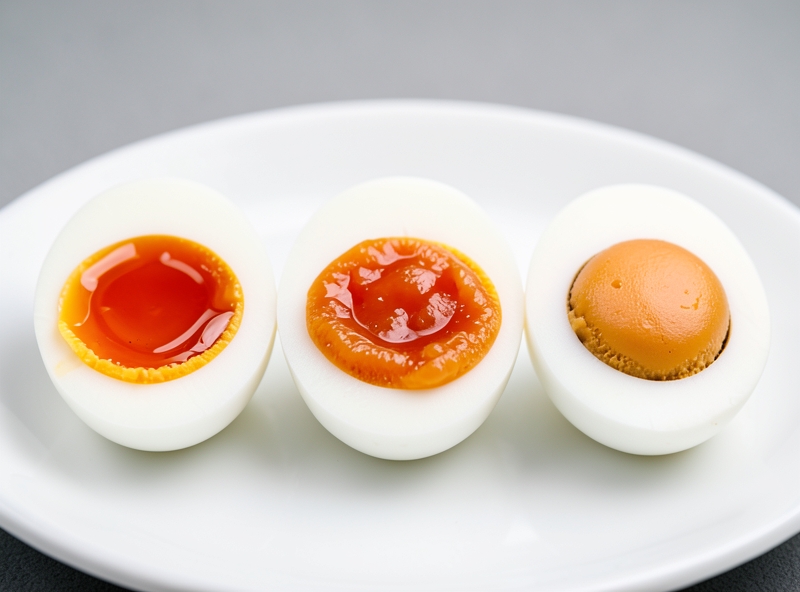
Mastering thermal denaturation allows you to conquer advanced culinary techniques with absolute success rates:
- Precision soft-boiling technique: The whites require high heat to set quickly, but the yolk must be kept below 68°C. Lower eggs directly into 100°C boiling water for exactly 6 minutes, then shock them immediately in an ice bath. This thermal shock stops heat propagation to the core, keeping the yolk rich and runny.
- Sous-vide technique (Onsen eggs): By setting a precision water bath at 63.5°C for 45 minutes, you force the whites to set delicately at the Conalbumin threshold (60°C) while the yolk reaches peak jammy richness without setting hard.
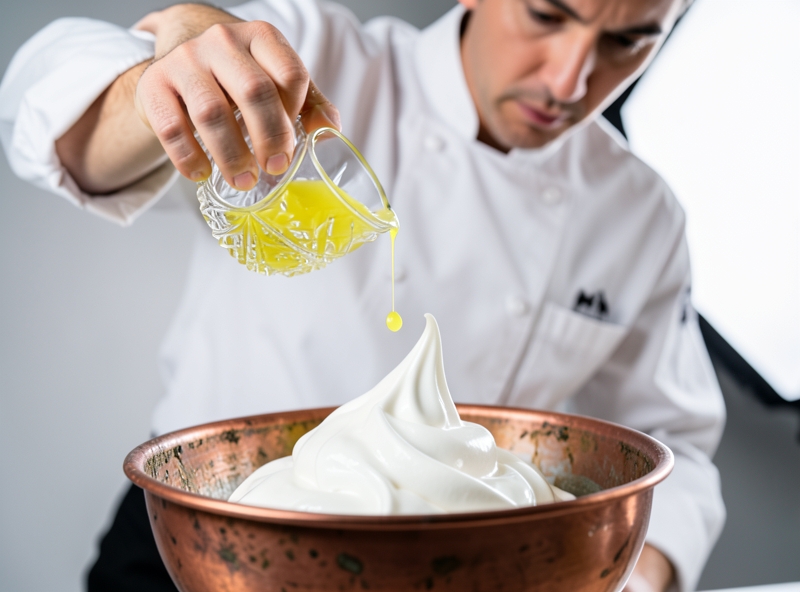
- Conquering silky Hollandaise sauce: Hollandaise sauce is an emulsion of fat (butter) and egg yolks. The temperature of the mixing bowl must be strictly maintained between 62°C - 65°C. This temperature is sufficient to gently denature the yolk, acting as a binder to create a rich, thick texture, without reaching the 68°C mark—the threshold where proteins curdle into ruined scrambled eggs.
When you master thermal denaturation, you no longer view temperature merely as a tool to cook food. You are controlling molecular structure to craft the ultimate culinary experiences.
3. Impact of Mechanical Force: The Secret Behind the Airy Meringue Structure
Have you ever watched a Pavlova deflate just minutes after leaving the oven, or seen a meringue topping weep into a slushy puddle of liquid sugar? This failure isn't caused by inaccurate ingredient measurements, but by poor control over **mechanical force**—the decisive factor in the survival of the foam structure.
Egg whites consist of 90% water and 10% protein. In their natural state, these protein chains are tightly coiled like tangled skeins of yarn suspended in water. As the wire whisk begins to rotate, mechanical shear forces directly disrupt molecular bonds, triggering the process of **mechanical denaturation**.
Under the impact of whipping force, the protein chains uncoil. At this point, the dual nature of egg proteins emerges: the **hydrophilic** groups face the water molecules, while the **hydrophobic** groups immediately turn outward, clinging firmly to the newly incorporated air bubbles. As a result, a highly elastic protein film forms, encapsulating and stabilizing each microscopic air bubble, preventing them from coalescing and popping.
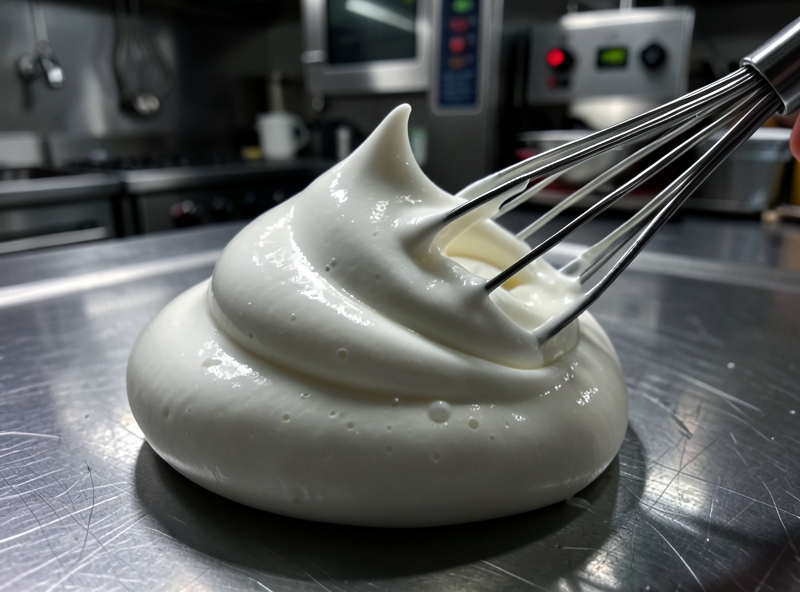
The meringue structure does not appear by chance. It undergoes a **step-by-step mechanical transformation process**, requiring bakers to observe with extreme precision to stop whipping at the exact right moment:
| Whipping Stage | Microscopic State of Protein | Sensory Indicators | Technical Application |
|---|---|---|---|
| Coarse foam | Proteins begin to uncoil; air bubble sizes are uneven. | Liquid mixture with large, soapy bubbles. | Add stabilizers (Cream of tartar/lemon juice). |
| Soft peaks | Protein film is strong enough to hold air while maintaining high elasticity. | Fine air bubbles; lifting the beaters forms peaks that curl gently downwards. | Used for Soufflés and Mousses requiring gentle rise. |
| Stiff peaks | Protein film is fully extended; high density of air bubbles. | Glossy, smooth mixture; peaks stand straight up; stays in place when bowl is inverted. | Used for Macarons, Pavlovas, and baked Meringues. |
| Overbeaten | Proteins are squeezed dry; excessively tight bonds force water out. | Grainy, curdled mixture; loses glossiness and rapidly separates/weeps. | Completely ruined (Irrecoverable). |
"Whipping egg whites is not merely mixing ingredients; it is the act of constructing a microscopic architectural network. Controlling the whipping force means controlling the elasticity of the protein film."
If mechanical force is the architect building the bubble framework, then the oven temperature is the solid concrete setting the entire structure in place. This is where the most abundant protein in egg whites—**Ovalbumin (accounting for about 54%)**—plays a crucial role.
Unlike other proteins that denature easily at room temperature during whipping, **ovalbumin** is remarkably heat-stable. As the meringue goes into the oven, only when the temperature rises significantly (around 80°C) does ovalbumin fully coagulate. It transforms into a solid matrix, permanently locking the bubble walls in place before the air inside can expand and escape. Without the thermal denaturation of ovalbumin, the meringue would instantly collapse into liquid as soon as it cools down.
To optimize mechanical force and achieve peak protein denaturation efficiency, follow these three core principles:
- Control Initial Temperature: Egg whites at **room temperature (20°C - 25°C)** have lower surface tension than cold eggs, allowing mechanical force to stretch protein chains more easily and whip air in faster.
- Timing Sugar Addition: Do not add sugar too early when the foam is still coarse, as sugar hinders protein shearing; add sugar gradually only when the structure reaches the **Soft peaks** stage to increase density and glossiness.
- Acid Intervention: A touch of acid (citric acid or cream of tartar) lowers the pH of the egg whites, preventing premature over-bonding of disulfide bonds, making the protein film more elastic and resistant to overbeating.
4. Controlling Auxiliary Ingredients to Master Every Egg Recipe
You precisely follow every degree on the stove and time every second perfectly, yet your scrambled eggs still release watery pools, and your beautifully puffed meringue in the oven turns into a watery mush after just a few minutes? The difference between an amateur cook and a culinary master lies not in the flame, but in the ability to orchestrate the chemical reactions of auxiliary ingredients on the egg's protein network.
Eggs are a complex emulsion of protein and water. When exposed to heat or mechanical force, protein chains unfold and cross-link with each other (coagulation). Without intervening agents, these bonds tighten too much, squeezing out all the water. The four auxiliary agents below act as "brakes," helping you control this structure precisely as desired.
| Auxiliary Ingredient | Biochemical Mechanism | Actual Textural Change | Recommended Golden Ratio |
|---|---|---|---|
| Acid (Lemon, Cream of Tartar) | Increases H+ ions, lowers pH, adds a positive charge to protein chains to counteract excessive disulfide bonding. | Keeps egg white foam (Meringue) pliable, preventing it from drying out or weeping. | 1/8 tsp Cream of tartar (or 1/2 tsp lemon juice) per egg white. |
| Sugar | Absorbs water (hygroscopic), inserts between protein molecules to slow down denaturation. | Raises the coagulation temperature, making the egg mixture smooth, glossy, and deeply hydrated. | 30g - 50g sugar per egg white (depending on desired meringue stiffness). |
| Fat (Butter, Cream, Milk) | Coats hydrophobic (water-repelling) molecules, preventing proteins from bonding too densely. | Disrupts the protein network, creating a melt-in-your-mouth, rich, and creamy texture. | 15g unsalted butter per 2 large eggs (for Scrambled Eggs). |
| Salt | Isolates ions, weakening electrostatic bonds at room temperature while accelerating coagulation when heated. | Salting in advance helps retain moisture within proteins; salting late enhances flavor richness. | 1g salt (about 1 small pinch) for 2 eggs, whisk well 15 minutes before cooking. |
Clinical Troubleshooting: Fixing 3 Classic Kitchen Disasters
Once you understand the chemical nature, any failure on the plate can be traced back to its root cause and thoroughly resolved right from the preparation stage:
-
Issue 1: Meringue weeping (syneresis) or clumping like soap suds.
Cause: Over-whipping the egg whites, causing free ovalbumin bonds to tighten too much and force water out.
Solution: Add Cream of Tartar right at the foamy stage. The acid will slow down the bonding process. If slight weeping has already occurred, immediately whip in 1 fresh egg white with 1 teaspoon of sugar to restore the emulsion. -
Issue 2: Scrambled eggs turn out dry with water pooling at the bottom of the plate.
Cause: Excessive heat combined with a lack of protective fats causes proteins to contract rapidly (protein syneresis).
Solution: Whisk eggs with 1 tablespoon of cold butter/cream and a small pinch of salt 15 minutes before cooking. Salt helps reduce protein charges, trapping water molecules inside the gel structure. Turn off the heat when the eggs are still slightly wet (about 80% cooked) to allow residual heat to finish the rest. -
Issue 3: Fried/boiled egg whites become rubbery.
Cause: Rapid coagulation at high temperatures in a low-moisture environment.
Solution: For fried eggs, add 1 teaspoon of water to the pan and cover with a lid. Accumulated steam lowers the pan surface temperature, allowing whites to cook gently with steam heat instead of parching in hot oil.
"In the art of cooking eggs, seasonings are not just for flavor. They are subtle chemical agents that dictate the survival of the dish's texture."
Mastering these auxiliary factors completely eliminates guesswork from your kitchen. With precise adjustments of a pinch of salt, a few drops of acid, or a touch of fat at the right time, you can easily turn ordinary eggs into culinary masterpieces with textures perfected down to the millimeter.
5. Conclusion
The only difference between a velvety smooth Hollandaise sauce and a broken, lumpy mixture lies in an understanding of chemistry, not luck. Traditional recipes often mislead us with vague, qualitative instructions, leaving cooks passive and repeatedly facing unexplained failures. Bridging the gap between food science theory and practical hands-on skills is the "golden key" to fully mastering your kitchen.
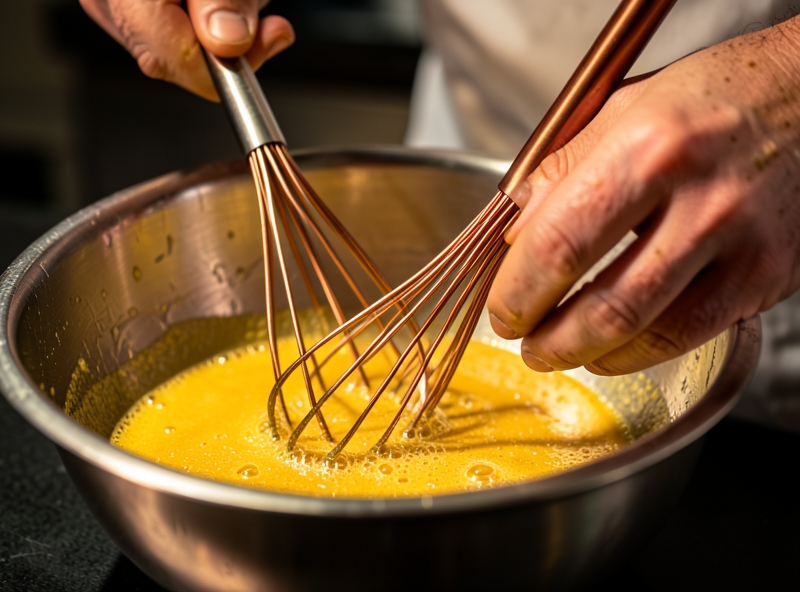
Look at egg protein—the perfect paradigm for the connection between science and culinary skill. By mastering temperature (thermal energy) and mechanical force (kinetic energy), you directly control the unfolding of amino acid chains (denaturation) and their reconnection (coagulation). A precise temperature hold at 64°C keeps egg yolks rich and jammy, while a proper whisking rhythm creates a stable air foam matrix for a fully risen Soufflé. This is not "cooking by intuition," but calculated physical-chemical reactions.
"Recipes only tell you 'WHAT' and 'WHEN,' but food chemistry knowledge gives you control over 'WHY' and 'HOW.'"
When you stop mechanically copying recipes and begin viewing ingredients at a molecular level, your culinary mindset will enter a new era. You will no longer fear mishaps like broken sauces, collapsed cakes, or tough, dry meat, because you know how to **adjust variables** right during the cooking process. Mastering science frees you from being a "slave to recipes," allowing you to step up as a creative **"chemist"**—one who holds total control over flavor, texture, and culinary art in their own kitchen.