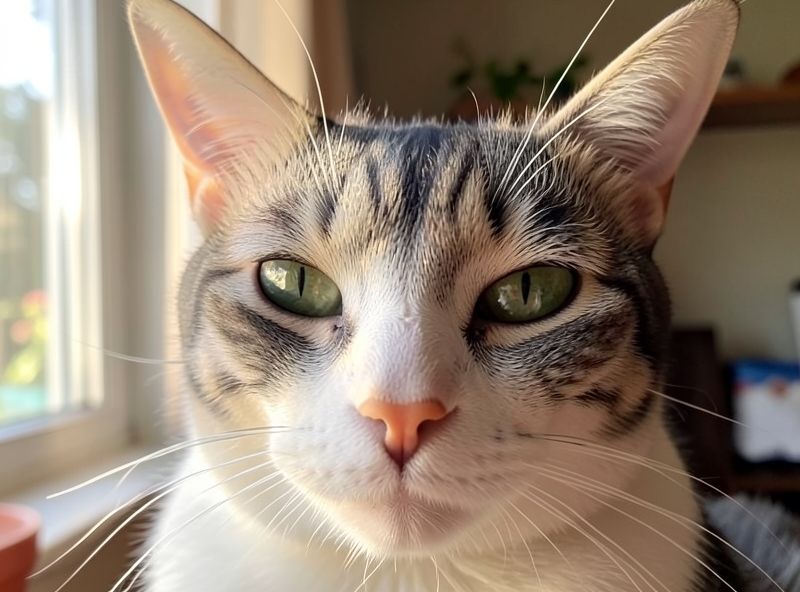
1. Eyes - The Window to the Soul and a Cat's Subtle Way of Communicating
Imagine a cat's eyes as a hyper-sensitive radar screen, not only helping them scan every movement in the dark but also acting as a display for silent emotional films. In our world, speech is the primary communication tool, but for cats, a squint or a stare carries as much weight as a long speech. Understanding this "gaze language" is the master key, helping you step through the door that separates the two species to build a deep, lasting friendship.
"A cat's eyes are not just for seeing; they are a wireless transmission system where every dilation and contraction of the pupils is a secret code of love or a subtle warning."
Biologically speaking, cats are natural-born "predatory warriors." Their eyes are designed like large-aperture camera lenses, capable of capturing maximum light to track prey. In the natural world, looking directly into an opponent's eyes is often considered a challenge or a sign of aggression. However, when living with humans, cats have "upgraded" this mechanism into a highly complex method of expressing affection. Understanding when those eyes are "smiling" and when they are "signaling for help" will determine the quality of the relationship between you and your four-legged friend.
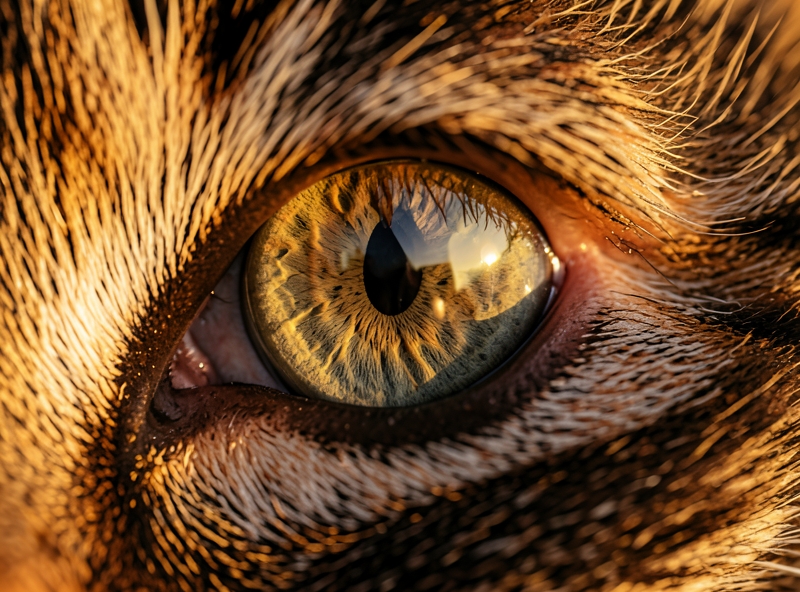
To become a "psychological expert" for cats, you need to distinguish between different pupil states – which function like curtains adjusting the light into the room of their soul:
| Pupil State | Message Meaning | Everyday Example |
|---|---|---|
| Dilated and Round | The cat is feeling excited, fearful, or very surprised. | Like when you suddenly see a gift you've wanted for a long time. |
| Constricted into Vertical Slits | Indicates high focus, anger, or being in a defensive state. | Similar to squinting your eyes to thread a needle or when focusing intensely on a debate. |
| Slow Blink | This is an "eye kiss," expressing absolute trust and love. | Like a warm hug or an affirmation: "I feel safe being with you." |
Learning to communicate through eye contact with cats doesn't require talent, but rather meticulous observation and a patient heart. Instead of staring, which makes them feel threatened (like a stranger staring at your face on a bus), try giving them a very slow blink. That's how you say "I love you" in cat language, helping to break down barriers and create an invisible but incredibly strong bond.
- Always maintain a reasonable distance when making eye contact so the cat doesn't feel pressured.
- Observe the combination of the gaze and other body parts like the ears and tail for the most comprehensive view.
- Respond to your cat's "eye kiss" to strengthen trust and the bond between both parties.
2. The Science Behind the 'Eye Smile': Decoding Slow Blink Behavior
Many cat owners often delude themselves into thinking their pets have affectionate "anthropomorphic" expressions. However, rather than believing cliché hearsay from pet lover forums, we should look at actual data from laboratories. In 2020, a team of psychologists at the University of Sussex and the University of Portsmouth (UK) conducted a serious study to prove that: A cat's slow blink is not laziness, but a calculated communication tool.
The study, published in the journal Scientific Reports, identified a clear feedback mechanism: Cats tend to slow-blink back at their owners after the owner proactively initiates the behavior. They are even more likely to approach a stranger if that person performs the "eye smile" technique. This shatters doubts about cats being creatures completely indifferent to human communication efforts.
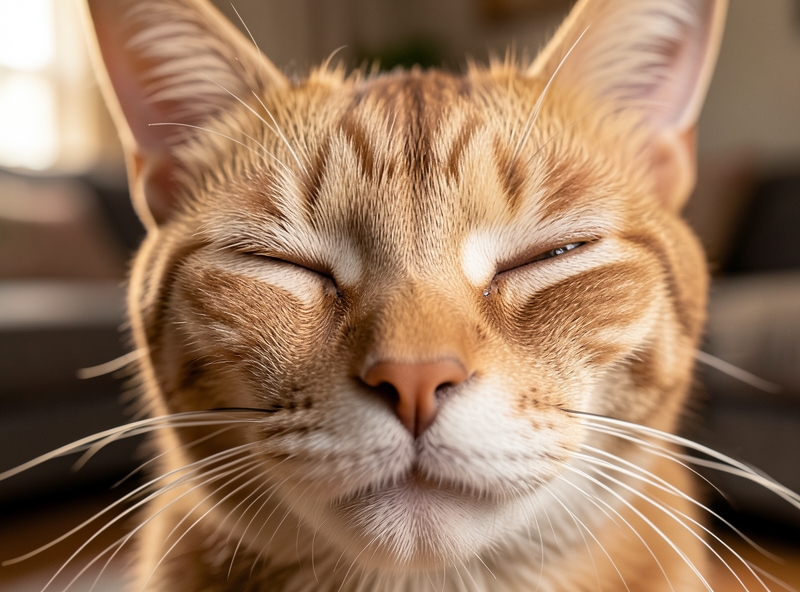
To understand why narrowing the eyes is considered a "peace message," we need to look at the issue from an evolutionary biology perspective. In the natural world, wide-open eyes are a sign of alertness, threat, or preparation for an attack. For a species that is both a predator and prey like the cat, maintaining vision is a survival instinct. Therefore, the act of slow blinking—or in other words, voluntarily closing one's vision for a split second—carries a very specific meaning:
- Disarmament: By closing its eyes in front of you, the cat is signaling: "I do not consider you a threat, and I have no intention of attacking you."
- State of Contentment: This is when cortisol (stress hormone) levels are low, allowing the orbicularis oculi muscles to relax.
- Establishing a Safe Boundary: Unlike staring—which is considered aggressive behavior—slow blinking is an effort to soothe the communication space.
| Behavioral Characteristics | Staring | Slow Blink |
|---|---|---|
| Biological Meaning | Threat, challenge, or pursuit. | Trust, friendliness, peace. |
| Cat's Reaction | Tense, pupils dilated or extremely constricted. | Relaxed, facial muscles loosened. |
| Communication Purpose | Establishing control/dominance. | Maintaining and strengthening social bonds. |
"The narrowing of the eyes in cats bears a striking resemblance to the Duchenne smile in humans (a genuine smile involving the eye muscles). It demonstrates a level of trust where they are willing to relinquish their ability to observe their surroundings."
Looking at it pragmatically, if you want to "manipulate" the psychology of a difficult cat, don't just try food or meaningless cooing. Try applying the research results from Sussex: Narrow your eyes, blink gently, and wait for a response. However, it should also be noted that this is not a panacea for all behavioral issues; it is merely a key to opening the initial door of trust. If you expect a blink to replace cleaning the litter box or a standard nutritional regimen, you have misinterpreted behavioral science.
3. Deciphering Other Emotional States Through Pupil Size and Gaze Direction
During my journeys through distant lands, I have realized that the gaze is always the most primitive language, a kind of "sacred script" that requires no translation. For our four-legged friends, eyes are not just visual organs but a mirror reflecting evolutionary heritage and silent emotional waves. When observing pupil size closely, we are truly touching their deepest emotional pulse.
| Pupil State | Emotional Analysis | Common Causes |
|---|---|---|
| Dilated (Mydriasis) | Extreme excitement or fear and insecurity. | Hunting, a new toy, or facing a potential threat in the dark. |
| Constricted (Miosis) | Stress, intense focus, or an expression of aggression. | Targeting, feeling provoked, or ready to attack. |
Pupil dilation is like a kaleidoscope trying to capture the maximum amount of information from the surrounding world. When a cat's pupils dilate in a bright room, it is often not a physical reaction to light, but a burst of adrenaline—a sign of excitement at seeing prey (or a feather wand). Conversely, pupils narrowing into a thin slit carry the nuance of a "warrior" calculating distance and angles, full of caution and sometimes a warning of rising discomfort.
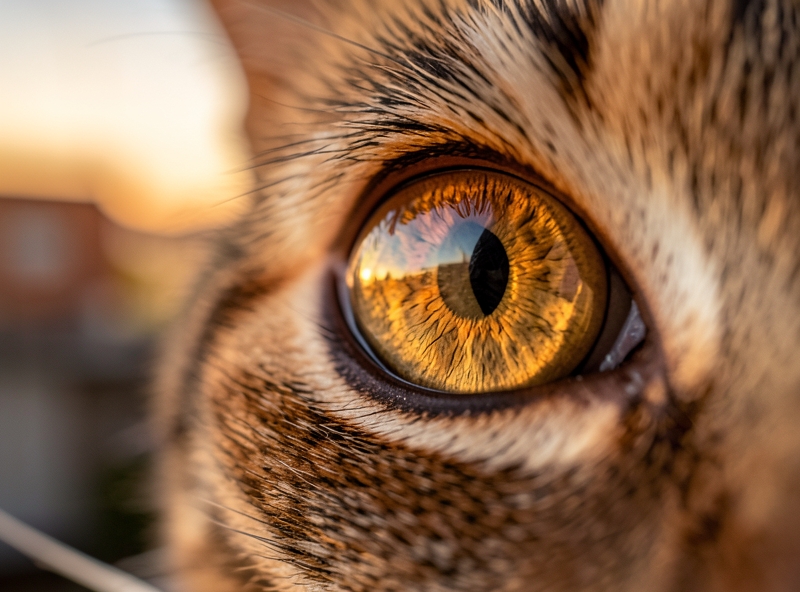
Gaze direction also tells an enchanting story of hierarchy and curiosity. In the natural world, an unblinking stare is often a direct challenge, a psychological battle for power. If you see your pet staring at you without breaking eye contact with a stiff body, it may be possessiveness or confrontation. However, a curious gaze is entirely different: the head tilted slightly, eyes sparkling yet soft, moving fluidly with your every motion—that is an expression of a longing to be understood and connected.
"In anthropology, we call it cultural intersection; in the pet world, it is the moment two souls of different species find a common rhythm through an empathetic gaze."
Specifically for cats, insecurity is often revealed through a "dance of the eyes." A cat feeling unsafe will never fixate on one point. Instead, their gaze will dart continuously from exit routes to hidden corners in the room. This is a survival reflex of their ancestors in the wild, who always had to scan for risks in their environment. Identifying this continuous movement helps us provide timely comfort, creating a quiet space to soothe the instincts rising strongly within our little friend.
- Staring: An assertion of dominance or a determined request for something.
- Looking sideways or avoiding eye contact: A sign of submission or a desire for reconciliation, avoiding conflict.
- Rapid eye movement: A state of high alertness or seeking an escape route due to fear.
4. The Art of Building Absolute Trust Through Eye Contact Techniques
In the feline communication ecosystem, eyes are not just visual organs with ultra-high resolution, but also "gateways" for transmitting incredibly complex emotional data. If you consider building a relationship with a cat as a process of establishing a security protocol, then the Slow Blink technique is the digital "handshake" that authenticates absolute trust. This is not merely a random action, but a biological algorithm pre-programmed into the feline genetic code to announce: "I am not a threat."
"The Slow Blink is a form of 'calming signal,' letting the other party know that your defense system is set to 'off' and you are ready to open up for connection."
To execute the Slow Blink "protocol" most accurately, please follow this 4-step processing workflow:
- Step 1 - Connection Initialization (Calibration): Choose a distance far enough away so the cat doesn't feel their personal space is being invaded. Relax your facial muscles, especially the muscles around the eyes, to avoid creating "visual stress."
- Step 2 - Signal Transmission (The Slow Close): Slowly close your eyelids. Imagine you are watching a slow-motion video at 0.25x speed. Closing your eyes completely sends the message that you are willing to temporarily give up your ability to observe in order to trust the other party.
- Step 3 - State Latency: Keep your eyes closed for about 1-2 seconds. This is the necessary "latency" period for the cat to process the input information.
- Step 4 - Re-opening Observation: Open your eyes gently and look slightly away to reduce direct pressure.
| Visual Behavior | Biological Mechanism | Cat's Reaction |
|---|---|---|
| Staring | Triggers "Fight or Flight" reflex | Tense, defensive, potentially aggressive. |
| Slow Blink | Releases Oxytocin (The happiness hormone) | Relaxed, responds by blinking back. |
| Avoiding eye contact | Signal of submission or lack of interest | Feels safe, more easily approachable. |
A very serious "syntax error" that owners often make is staring directly into a cat's eyes for too long. In the dictionary of apex predators, unblinking staring is a behavior of challenge or targeting for an attack. This causes an emotional "DDoS" that overloads the cat's nervous system with pressure. Remember: Always keep your gaze soft and take breaks so the cat doesn't feel "target-locked."
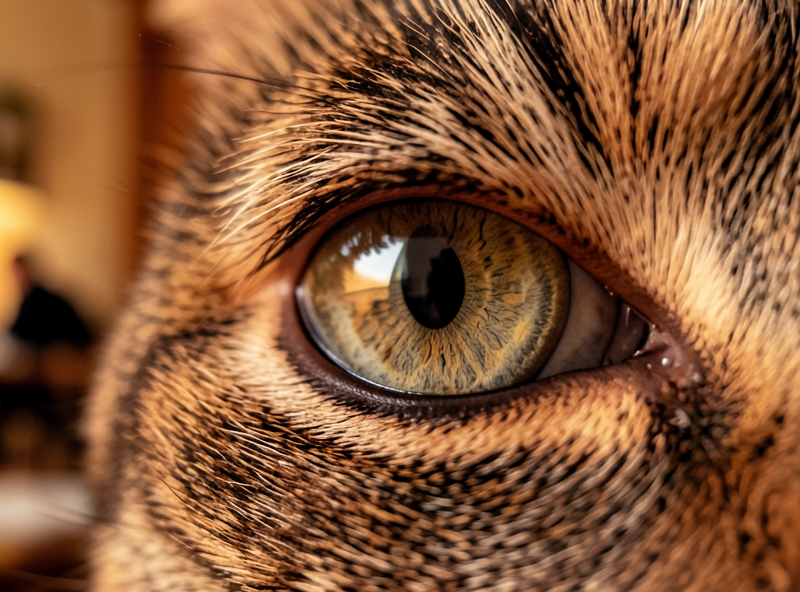
For special "cases" such as shy cats or newly rescued cats, combining the Slow Blink technique with the Safe Distance Protocol is mandatory. Do not attempt immediate physical contact. Sit at a diagonal angle, lowering your body's center of gravity to avoid creating an intimidating physical presence, then perform the slow blink sequence. When the cat responds with a similar blink, that is the "Access Granted" signal, allowing you to move closer to begin physical interactions like petting.
5. Frequently Asked Questions (FAQ)
Raising a cat is much like starting to live with a mysterious foreign friend. Some of their actions make us burst into laughter, while others leave us scratching our heads in confusion. Below are the little stories behind the "indecipherable" gestures that I frequently receive questions about from fellow cat lovers.
Why does my cat stare at me while I'm sleeping?
Have you ever woken up with a start to find "His Majesty" sitting right next to your pillow, eyes fixed intently on you? Don't worry too much; they aren't plotting anything. In reality, cats are animals with very high territorial instincts. When you sleep, you are in your most vulnerable state. Their staring is sometimes just their way of keeping watch over their clumsy "human servant." Or more simply, it's just curiosity about your steady breathing, or a gentle reminder: "Hey, it's almost breakfast time!".
Do cats understand when I wink at them?
In the feline world, staring without blinking is usually a sign of a threat. Conversely, a wink or a "slow blink" is an ocular "kiss." When you wink at them, you are sending a message of peace: "I trust you and I am not dangerous." If your cat blinks back at you, congratulations—you've officially been added to their "family" list.
"A slow blink from a cat is worth more than a thousand words; it is the intersection of absolute trust in the animal kingdom."
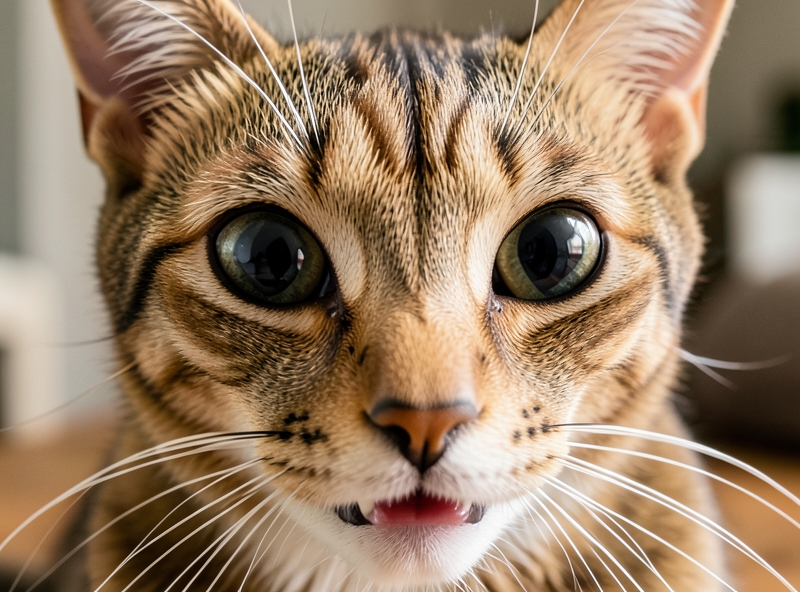
Why do a cat's pupils suddenly dilate while playing?
You will see this phenomenon most clearly right before they pounce on a string or a plush mouse. This is a natural physiological response to a surge in Adrenaline. When the pupils dilate, the cat's eyes take in more light and a wider field of vision, helping them calculate the distance and speed of their attack with maximum precision. At this moment, they might look a bit "derpy" with those big black eyes, but they are actually in the highest state of focus of a true hunter.
What should I do when my cat keeps staring into thin air?
Folklore often jokes that cats see "ghosts," but science has a much more interesting explanation. Cats have hearing and vision that are many times more sensitive than humans. They might be hearing a woodworm gnawing inside the wall, or seeing tiny dust motes reflecting sunlight that the human eye normally can't catch.
Instead of being afraid, you can try these steps to "decode" the mystery with your cat:
- Check for sounds: Try to listen closely for insects or strange noises coming from the wall.
- Distraction: If the cat seems stressed (ears pinned back, tail twitching violently), use toys or treats to redirect their attention elsewhere.
- Join in: Sometimes I joke around by coming over to pet their head and asking: "What's so interesting over there?". This action helps the cat feel more secure if they are wary of something unfamiliar.
| Behavior | True Meaning | Advice for Owners |
|---|---|---|
| Slow blinking | Expression of love and trust | Blink back to reciprocate the affection |
| Dilated pupils | Excitement or hunting | Avoid putting your hands close if you don't want to get scratched |
| Staring into space | Detecting sounds/small objects | Just let them be; it's their natural instinct to explore |