
1. What are micro-expressions and why can't we hide them?
Have you ever had a "gut feeling" when a partner smiles in agreement, even though their words are extremely persuasive? That's not supernatural intuition; it's your brain catching a micro-expression – tiny "cracks" in the social mask that the other person is trying to maintain. In high-level communication, those who master micro-expressions hold the key to reading minds without needing any confession.
Pioneered by Dr. Paul Ekman, micro-expressions are involuntary facial expressions of emotion that appear and disappear in the blink of an eye – typically lasting only 1/15 to 1/25 of a second. Unlike macro-expressions that we can control to "act" in front of a camera or in a meeting, micro-expressions are a leakage of true emotion, occurring before the conscious mind can intervene to cover them up.
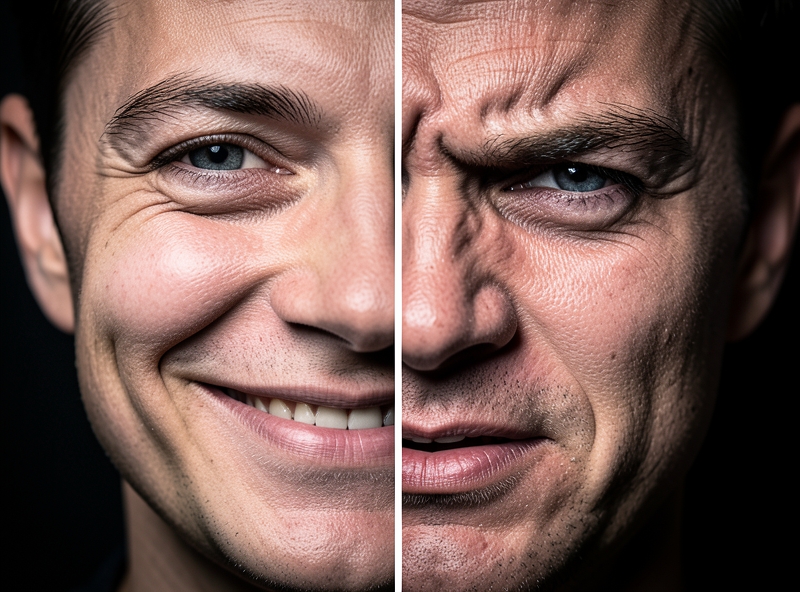
Why can't we control them? The answer lies in the survival mechanisms of the nervous system. The human face is controlled by two distinct neural systems:
- Pyramidal tract: Controls conscious movements. This is the tool you use to "craft" a polite smile when meeting a client.
- Extrapyramidal tract: Controls unconscious reflexes and authentic emotions. This system connects directly to the limbic system – the emotional center of the brain.
When a sudden emotional stimulus hits (fear, disgust, happiness, or guilt), the limbic system reacts immediately by sending signals to facial muscle groups. It takes a brief moment afterward for the cerebral cortex to recognize the situation and command the pyramidal system to "clean up" the scene. The short time gap between instinctive reflex and rational control is exactly when the micro-expression appears.
"Micro-expressions are the naked truth of human beings. You can lie with words, but your facial muscles don't have an 'off' switch for neural reflexes that have existed for millions of years."
| Characteristic | Macro-expression | Micro-expression |
|---|---|---|
| Duration | 0.5 seconds to 4 seconds. | Under 0.5 seconds (instantaneous). |
| Origin | Conscious or social habit. | Unconscious, automatic neural reflex. |
| Reliability | Low (easily faked). | Extremely high (reflects true emotion). |
| Scope | Entire face, clear. | Usually appears in a specific muscle area. |
The inability to hide micro-expressions makes them an "Achilles' heel" in negotiation and relationship building. If you are talking about a promising business plan but your lips slightly purse and tighten for 1/20 of a second (a sign of suppression or anger), a master communicator will immediately recognize the incongruence. The mismatch between words and micro-expressions is the source of distrust, causing your efforts to build credibility to collapse even before you finish your sentence.
2. Decoding 7 Basic Emotions Through the Subtlest Facial Movements
Have you ever felt something was "off" even though the other person was smiling? Or wondered why a potential deal suddenly fell through despite the partner's continuous nods of agreement? The truth is: The body can lie, but the facial muscles cannot. Paul Ekman, a leading psychologist, has proven that there are 7 universal emotions expressed through "micro-expressions" lasting only about 1/25th of a second. If you aren't keen enough to recognize them, you are completely blind in important negotiations.
To become a "mind-reading master," focus on observing subtle changes in the three "golden triangle" zones: eyebrows, eyelids, and the corners of the mouth.
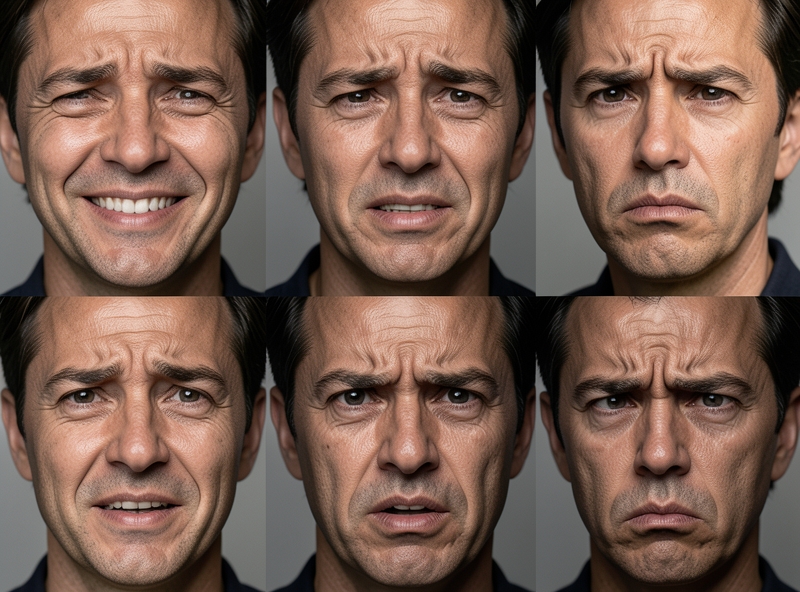
Below is a detailed map for you to peel back each layer of true emotion behind social small talk:
- Happiness: Don't look at the mouth; look at the eyes. A genuine smile (Duchenne smile) requires the contraction of the orbicularis oculi muscle, creating crow's feet at the outer corners of the eyes and raising the cheeks. If the corners of the mouth turn up but the eyes remain still, it is a soulless social smile.
- Sadness: This is the hardest emotion to fake. The hallmark sign is the inner corners of the eyebrows being drawn together and slightly upward. Simultaneously, the upper eyelids droop slightly, and the corners of the mouth tend to pull downward.
- Fear: Eyebrows are raised and pulled together in a straight line. The upper eyelids open wide to reveal the whites, while the lower eyelids are tensed. This is an instinctive reaction as humans try to expand their vision to find an escape route.
- Disgust: Attention shifts to the nose and upper lip. The nose wrinkles, the upper lip is pulled upward, sometimes revealing teeth, while the lower lip may slightly pout. This is a manifestation of "closing off" the senses to a negative stimulus.
- Anger: Eyebrows are lowered and pulled firmly together, creating vertical wrinkles between the forehead. The gaze is a piercing, aggressive stare, the lower eyelids are tensed, and the lips are pressed firmly into a straight line or opened in a square shape in preparation to shout.
- Surprise: This occurs the fastest. Eyebrows are raised high in an arch, eyes open wide, and the teeth are slightly parted, creating a natural gap at the mouth. Unlike fear, the facial muscles are in a more relaxed state, without tension.
- Contempt: This is the only emotion that shows asymmetry. One corner of the mouth will curl up or tighten. It is more discreet than anger but is "poison" in communication because it demonstrates a lack of respect for the other person.
| Emotion | Eyebrow / Forehead Area | Eye Area | Mouth / Nose Area |
|---|---|---|---|
| Anger | Pulled down, together | Staring, tensed | Pressed firmly or square |
| Fear | Raised, pulled together | Wide open, whites showing | Mouth open, pulled toward ears |
| Contempt | Little change | Looking down or sideways | One corner of the mouth raised |
"In a dialogue, information lies in the words, but the truth lies in the facial muscle movements that exist for only a split second."
Mastering these 7 types of emotions not only helps you avoid spectacular deceptions but also allows you to empathize deeply with the person across from you. When you notice a flicker of "sadness" pass over a colleague's face despite them saying "it's okay," that is when your subtle communication skills need to speak up to connect and soothe. Remember: A good communicator hears with their ears, but a master communicator observes with their entire presence.
3. How to Identify Inconsistencies Between Words and Real Emotions
Have you ever walked out of a negotiation with a strange sense of unease, even though the other party just nodded in agreement to every term? That intuition is not baseless. It is when your brain unconsciously catches the "cracks" in the social mask of the person opposite you. In high-level communication, words can be edited, but facial muscles are the most loyal traitors of the subconscious.
To become a master communicator, you must learn to read emotional leakage – those brief moments when true feelings "break through" the control of reason to manifest clearly on the face.
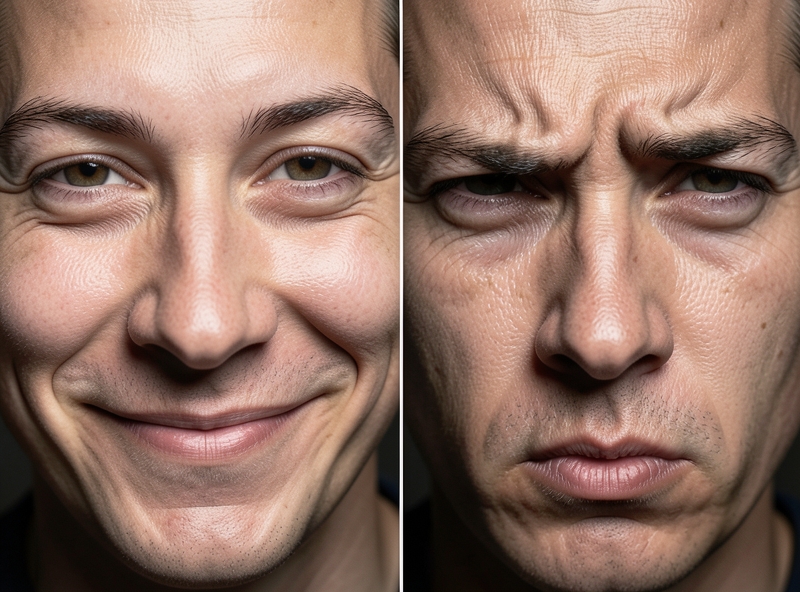
In-depth observation techniques focus on three vital areas to help you peel back the outer layer:
- Micro-expressions Scanning Technique: These expressions appear for only about 1/25 to 1/15 of a second. When an opponent says "I am very satisfied" but their eyebrows slightly furrow and then relax immediately, it is a sign of suppressed anger or anxiety.
- Distinguishing Duchenne Smiles from Social Smiles: A genuine smile doesn't start from the mouth; it starts from the eyes. Observe the Orbicularis oculi muscle.
- Facial Asymmetry: Natural emotions usually manifest symmetrically. If a smile or a smirk only appears strongly on one side of the face, it is evidence of "utilizing facial muscles" to create a fake emotion.
"The human body does not know how to lie. When words and body language conflict, always believe what you see, rather than what you hear."
| Observation Features | Genuine Smile (Duchenne) | Social/Fake Smile |
|---|---|---|
| Eye Area | "Crow's feet" wrinkles appear, cheekbones are raised. | Eyes are motionless, no contraction in the outer corners of the eyes. |
| Mouth Muscles | Pulled upward naturally by the zygomatic muscles. | Pulled horizontally toward the ears, looking tense and forced. |
| Timing | Appears and disappears smoothly, increasing gradually. | Appears suddenly or disappears too quickly (like flipping a switch). |
Facial asymmetry in deception occurs due to the conflict between the two brain hemispheres. The right hemisphere (controlling emotions and the left side of the face) tries to reveal the truth, while the left hemisphere (controlling logic, language, and the right side of the face) tries to execute a false script. The result is that one side of the face is often "truer" than the other.
To practice this skill, do not stare at the other person's eyes in a pressuring way. Use your peripheral vision and focus on the "expressive triangle" consisting of: eyes, nose, and mouth. When you notice a mismatch between a compliment and a slight smirk (a sign of contempt), that is when you need to re-ask questions to verify the truth instead of rushing to trust.
4. Applying micro-expression reading skills in communication and work
Have you ever felt a very firm handshake but the opponent's eyes were evasive, or an agreement "yes" but the corner of the mouth twitched slightly in a split second? That is not an illusion. That is micro-expressions – unconscious emotional leaks that take place in only 1/25 to 1/15 of a second, revealing the truth behind the most perfect social mask.
In the fierce business world, possessing micro-expression reading skills is no longer a personal hobby but the ultimate weapon of master negotiators and high-level CEOs. It allows you to see through what the opponent has not yet said or is intentionally hiding.
"In communication, the most important thing is to hear what isn't being said."
The application of this skill penetrates every core corner of professional success:
- Business negotiation: Identify contempt through a slight smirk when you offer a price. This is a signal that the opponent feels they have the upper hand, helping you adjust your tactics in time to avoid being "overcharged" at the negotiating table.
- Human resource management: Look out for potential fear or disgust during interviews or performance reviews. An employee saying "I'm fine" but their brow muscles furrowing for a split second is a sign of burnout or underlying dissatisfaction, helping managers prevent human resource crises before they occur.
- Building personal relationships: Rapport is most sustainably established when you respond correctly to the true emotions of the person opposite, creating absolute trust because they feel deeply "empathized" with.

When detecting a negative emotion – such as anger or disgust – flickering across the opponent's face, the biggest mistake most people make is direct exposure. This only puts the opponent in a defensive state and causes severe conflict. Top 1% experts will choose to "Subtly Pivot" according to the following roadmap:
| Recognition signal | Actual emotion | Subtle response (The Pivot) |
|---|---|---|
| Nose slightly wrinkled, upper lip pulled up. | Disgust/Dissatisfaction | Don't ask "You don't like it?". Say: "It seems we need to look closer at this point to optimize it for both parties." |
| Eyebrows raised and pulled together. | Anxiety/Fear | Lower your tone, provide more supporting data or confidentiality commitments to re-establish a sense of security. |
| One corner of the mouth turned up. | Contempt/Arrogance | Stop providing information. Ask a powerful counter-question to regain balance: "What is your perspective on this risk?" |
Mastering micro-expressions is not about becoming a "lie detector," but about becoming a communicator with superior emotional intelligence (EQ). By observing the smallest leaks, you can navigate the dialogue from the brink of collapse to consensus, turning potential conflicts into strategic cooperation opportunities.
Remember: The body doesn't know how to lie. When you learn to read the language of the tiny muscle fibers on the face, you hold the key to opening the psychological door of anyone you meet.
5. Important Notes to Avoid Mistakes When Reading People
Most people fail at reading others not because they lack knowledge, but because they are too confident in hasty conclusions. Reading people is not a magic trick to see into someone's soul; it is a process of gathering data and testing hypotheses. If you impose subjective prejudices, you aren't reading the other person – you are reading your own imagination.
The most common mistake that causes relationships to break down and negotiations to fail is the Othello Error. This is a phenomenon where a person misjudges the source of an emotion. When you see an opponent sweating, their voice trembling, or avoiding eye contact, you immediately conclude they are lying. But in reality, those expressions could simply be anxiety because they are being wrongly suspected. The emotion is real, but the cause behind it may be completely different from your prediction.

To become a master communicator, you must master the concept of the Baseline. Every individual has a unique "normal state." There are people who naturally shake their legs, speak fast, or dislike direct eye contact. If you don't identify their standard behavior in a relaxed state, you will easily mistake those personality traits for "abnormal signs."
"Context is the king of all psychological analysis. A smile at a funeral has a completely different meaning than a smile at a dinner party."
Never fall into the trap of concluding based on a single expression. In body language, we call this the rule of "Clusters." Crossing arms doesn't necessarily mean they are being defensive; they might just be feeling cold. A glance away doesn't mean they are being dismissive; they might be distracted by an outside noise.
| Factor | Common Mistakes (Amateur) | Correct Approach (Expert) |
|---|---|---|
| Signals | Believing in a single action (e.g., scratching the nose means lying). | Look for at least 3 signals appearing simultaneously. |
| Context | Ignoring the surrounding environment and specific situation. | Analyze the impact of temperature, noise, and social hierarchy. |
| Subject | Applying the same set of rules to everyone. | Establish a unique baseline for each individual before evaluating. |
Remember, the goal of reading people is to understand and connect, not to catch them out or manipulate them. When you focus too much on finding faults, you lose your natural sharpness and sincerity in communication. Keep a cool head to observe but a warm heart to empathize; that is the pinnacle of advanced soft skills.
- Stop: When you see an unusual expression, don't rush to label it.
- Observe: Look for additional supporting signs within the next 2-3 minutes.
- Verify: Ask open-ended questions to check if your hypothesis matches their actual reaction.
6. Summary: Awakening the "Sixth Sense" in Modern Communication
Micro-expression reading skills are not "mind-reading" magic, but the pinnacle of Emotional Intelligence (EQ). In a world where social pleasantries often mask the truth, identifying facial movements that occur in just 1/25 of a second is the key to seeing through invisible barriers. Grasping micro-expressions means you possess a sharp "radar," helping identify insecurity, hidden joy, or underlying resistance even before the other person manages to voice them.
The journey to mastering this skill has no shortcuts. It requires persistent practice and sharp observation skills. Start by observing the smallest expressions in daily conversations, from a fleeting frown to a slight contraction of the orbicularis oculi muscle. This subtlety doesn't come from mere theory but is crystallized from thousands of hours of observation practice and cross-referencing with real-world contexts.

However, with great power comes great responsibility. The line between a master communicator and a psychological manipulator lies in the purpose of use. Don't turn this skill into a weapon for prying or controlling others. Use it as a tool for empathy and connection. When you recognize a partner's hidden fear, instead of exploiting it, create a safe space for them to share. When you see an employee's hesitation, encourage them to resolve difficulties instead of pressuring them.
"Ultimate communication is not about what you say, but how much you feel from what is left unsaid."
| Old Mindset (Surface-level Communication) | New Mindset (Micro-expression-based Communication) |
|---|---|
| Focus only on words and tone of voice. | Decoding biological signals that cannot be faked on the face. |
| Reacting based on what is heard. | Acting based on underlying insights and real emotions. |
| Easily led by manipulative scripts. | Mastering the interaction through the ability to detect emotional contradictions. |
Finally, remember that the core goal of all soft skills is to build quality relationships. Understanding micro-expressions helps you eliminate unnecessary misunderstandings, build sustainable trust, and become a person of natural influence. Let subtlety in observation guide sincerity in behavior; that is the art of communication at the highest level.